Telling Their Own Story

I will start with the obvious: chefs and restaurants are trendy.  Above all, chefs in fancy white tablecloth restaurants have become important players in the making of the symbolic economy (that is the one in which you buy things—a sports car, a zucchini, a house, shoes—because it means something to you, not just because you need it).  Eating in their restaurants, reading and watching their interviews and TV shows and buying their cookbooks and other products are all part of the process by which we consumers make ourselves into the kind of people we think we want to be.  Through all of the media they create, these restaurateurs tell their own stories and make themselves into who we think they are…and help give meaning to our own dining and cooking experiences.

The process through which some of the more savvy chefs define themselves is fascinating to watch.  One of the difficulties faced by social scientists who want to study restaurateurs is precisely that they are great at telling their own stories.  They are good at connecting with the desires and ideas that permeate our societies.  The stories of chefs’ lives, of the highs and lows of kitchen life, of the creative process in the restaurant, of difficult customers or unusual settings to prepare a meal all help create a kind of template that the rest of us can use to frame our lives, culinary or otherwise.

There are no famous chefs or media stars in our Mid-City restaurant cluster.  But there are stories to tell, as we have already documented here.  Perhaps more importantly, the restaurateurs are, in many cases, already telling their own stories.  They use web pages and social media, along with more traditional media, to create this narrative.  Restaurants like Mandina’s and Brocato‘s have quite elaborate web sites, outlining their histories, including pre and post Katrina events, details about rebuilding and links to outside writing or video about them.  Of course, they also include menus, addresses and hours as well as contact information.  Not all the neighborhood restaurants have web sites (we list those that do on the right side of the blog) and not all of them have extensive information.  Some of the restaurants also have Facebook pages and some may also use other social media as well.  I am linked to several of them in this way and mostly get regular—and mouthwatering—reports of daily specials.

Still, the media are there and the restaurants are beginning to employ them to do more than simply announce specials.  They are using them to tell their stories and thus shape the way we think about them.  This is rapidly becoming an important part of how we can think about forces shaping the neighborhood and city.  The manner in which the restaurant owners represent themselves through their web sites and social media shapes our knowledge about them and will eventually help contour our understanding of the neighborhood beyond their doors.  All of this raises a lot of questions: why do some restaurants pursue this while others do not?  (In our study, restaurants catering to recent immigrant populations seem less likely to have extensive web sites, for example.)  Who reads the sites and what do they take away from that?  As restaurants reach out in this way, are they fundamentally changing the dining experience?

The fact that the people we are studying are telling their own stories through these public representations raises another set of issues as well.  What kinds of insights do anthropologists (or other social scientists) have that might be different from or complementary to information presented by the restaurants themselves?  If we are going to make our work useful, we have to be able to put the restaurant stories into a broader context.  We have to show how the restaurants in our cluster fit into and shape the contours of the city’s broader culture and history.  As the summer winds down and we start to look closely at our data, we will be concentrating on this.  The restaurateurs continue to tell us their stories, both directly and through their public representations.  Our job is to put this together and see if something emerges that gives us new ideas about restaurant clusters, neighborhoods, Mid-City and New Orleans.  Stay tuned!
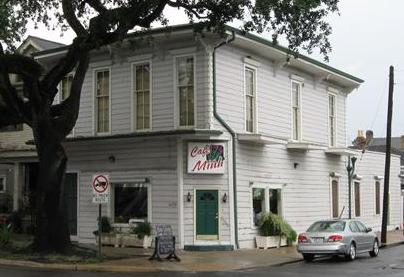
Minh-City Cafe

One of my research adventures took place at Cafe Minh. It is located in what used to be Michael’s Mid-City Grill before the storm. When the latter restaurant did not re-open Post-Katrina, Chef Minh Bui decided that it would be a fitting abode for his Cafe Minh.

With his roots in Vietnam, Chef Minh got his New Orleans start cooking at places such as Emeril’s and Commander’s Palace. After mastering his skills, he developed a Vietnamese-French fusion cuisine that contains hints of local Creole cooking. His first restaurant Lemongrass was opened next to Angelo Brocato’s on Carrollton Avenue. A second location of Lemongrass located in the International House hotel was opened, and a third restaurant called 56 Degrees was also opened in the Whitney Hotel. Before Katrina, both the Carrollton location and 56 Degrees closed. After the storm, Chef Minh decided he wanted to return to Mid-City and opened Cafe Minh at its current location.

Cafe Minh fits perfectly in the Restaurant Row even though it is not physically in line with the others. About a block into Canal Street, it is still in close walking distance of the area, however. One thing we can recognize about the Restaurant Row is that even though there may be similar types of food (for instance, Wit’s Inn, Venezia, Theo’s, Papa John’s and Domino’s all have pizza), there is still enough variety throughout the restaurants that they are all able to survive. Among the Asian restaurants, you may find that Little Tokyo, Doson’s Noodle House, Yummy Yummy, and even Cafe Minh have similar items on the menu. Yet because of the creativity of the chefs, the different environments of the restaurants themselves, and the specific cravings of those searching out food, co-existing is not a problem for these places.

Another similarity I have noticed between the Asian restaurants is that the owners or head chefs all learned to cook in their birth countries. This seems to come full circle as they originally learn to cook in the authentic way of their birthplace, then they end up drifting into another type of cuisine (whether it be another Asian cuisine or something completely different), and in the end, they come back to their original style of cooking, adding a bit of their own flair. That little bit of flair and originality is what sets each of these restaurants apart from the other.

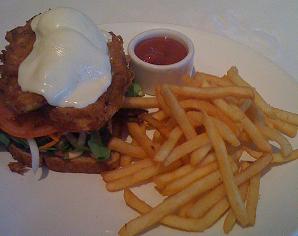
During my visit, I discovered that the food at Cafe Minh is excellent, however, when one typically thinks of the item he or she is ordering, one might not get exactly what they are expecting. For instance, when I ordered the fried eggplant, I did not expect it to be topped with mozzarella, on top of tomatoes, on top of a bed of lettuce, on top of toast. It was amazing nonetheless. This is an example of Chef Minh’s genius at work.

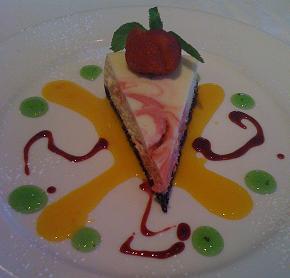
For dessert I had the white chocolate raspberry cheesecake, and it was divine. Colorful and divine.

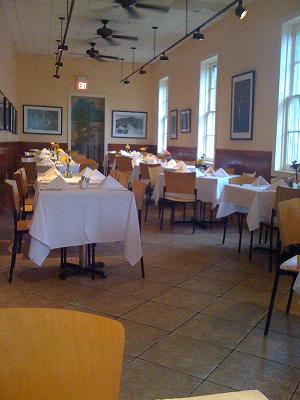
Also, while visiting Cafe Minh, I immediately noticed all of the artwork on the walls. With the high ceilings and ambient lighting, I almost felt that I was in an art gallery for a moment. The bartender even told me that the artwork is rotated by several local artists throughout the year.

When wandering Mid-City and you find yourself wanting something different than the norm, try stopping by Cafe Minh. If anything, the experience is one you’re unlikely to find anywhere else on Restaurant Row.

Paul Ballard, A New Orleans Inspired Wingman

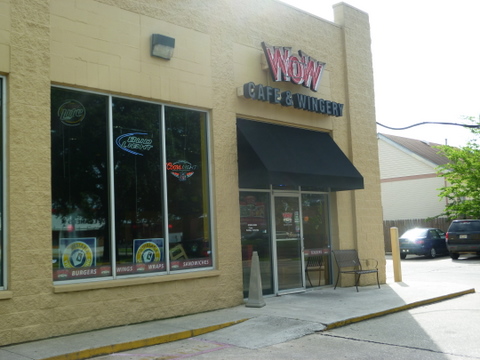
Wow!

This past week I had the opportunity to sit down with Mr. Paul Ballard, president and CEO of WOW Café and Wingery. Mr. Ballard is a larger than life kind of man with a captivating grin and a presence that leaves listeners hanging on his every word. His strong family ties and love for all things New Orleans were evident within the first several minutes of our encounter. We were just sitting down at a table overlooking a rainy Orleans avenue sipping cold brewed coffee when Mr. Ballard first surprised me by immediately thanking me for our interest in his company. For the first time in a long while I did not feel as though I were pestering someone who had more important work to do than indulge the curiosities of a budding young anthropologist. It was also about this time that I learned Paul was a title that Mr. Ballard was more comfortable with.

Paul is a first generation New Orleanian, who grew up in a music store, Tape City USA, owned by his parents. They operated locations in Metairie, the CBD, and on Carrollton Avenue. Paul said it was a big day for them when then franchisee Nancy Bounds opened the Mid City location. “It was exciting for us to be back in the neighborhood”, Paul said with a smile. This excitement, he later claims, was one of the main reasons he and his brothers, also his partners in WOW, thought it was important to get back open after the storm.

Paul graduated from Tulane University with a degree in History and an intention of going on to Law School. It was while he was attending Tulane he met his wife, and future mother of his 4 children (the youngest only a matter of weeks old). Like many of New Orleans’ college students he found work at several bars and restaurants around town. Sal & Sam’s, which he defined as New Orleans Italian fine dining, required he wear a tuxedo and understand the importance of a good sauce, a notion that stuck with him as the WOW franchise began to grow.

Paul also recounted his experiences as a bartender at Rosie’s Big Easy on Tchoupitoulas. “Having been around for the progression from 4 track and 8 track players to LPs and so on, working at Rosie’s, just down from Tipitina’s, was a blast. We grew up around the music”. He went on to say how he feels very connected to New Orleans culture. He spent parts of his childhood all over this city, and says that when he sees a WOW in some of his old stomping grounds he cannot help but feel good.

Paul’s narrative is a great example of how culture reshapes itself. He grew up part of New Orleans music and food scene. Now he and his wife are raising their own children in an entrepreneurial environment. They are exposing them to an avenue that is clearly one of the cornerstones of New Orleans identity: food. Hot wings and beer may not be the first thing you think of when you think New Orleans food, but the Ballard family has dedicated themselves to creating and spreading representations of New Orleans. I will explore more of this next week when I discuss the connections that Paul has established over the years including his links to PJ’s Coffee founder Phyllis Jordan, and Chefs George Rhode and Paul Purdhomme.

“This is NOT a Cannoli” (But What Is?)

The very first day I went in to Brocato’s I was overwhelmed by the sheer variety of confectionary delights.  Some things were familiar to me as things that are distinctly Italian even though I myself may not have had them before.  There were jars of candy coated Almonds, a variety of biscotti to choose from, spumoni, and rum cake. Then there were the cannoli.  Or at least I thought they were cannoli.  However, they were listed as cannocini with a small sign below, distinctly stating: “This is NOT a cannoli.”  I was intrigued, because knowing what they were not did not help me in figuring out precisely what they were.  They appeared to be Italian cream filled cylinders, and I was failing to distinguish the difference.

My confusion regarding Brocato’s wares involved their frozen treats as well.  During our interview, Arthur Brocato repeatedly referred to his frozen concoctions as “Italian ice creams”.  I had considered them to be gelatos and ices.  When I looked to their website for clarification, I noticed the following: “For the true connoisseur, Brocato’s offers a complete selection of “gelato” (Italian for ice cream) featuring all natural imported Sicilian flavorings from chestnut to moka to amaretto.”

So, according to Brocato’s, “gelato” is Italian for “ice cream”.  Not being convinced that there wasn’t a bigger difference, I scoured the internet, and after looking through numerous Chowhound posts, Wikipedia postings, About.com answers and endless other streams of running commentary on the subject, I gathered that the general consensus is that gelato actually contains milk and cream as opposed to just cream and that the fact that is seems to be superbly creamy in comparison to its ice cream counterpart has more to do with the fact that it is mixed slowly enough that air doesn’t whip in, allowing for a much denser creamy texture.  As for the cannocini: when I finally gathered the determination to display my ignorance of Italian desserts and ask for the difference, I was told that they are filled with sweetened custard filling rather than sweetened ricotta as the cannoli are.

I bring up the cannoli and gelato examples not because I wish to nitpick Brocato’s selections and word choices but because I think they serve as excellent examples when it comes to the endless debate on authenticity. If Brocato’s chooses not to call its Italian Ice Cream “gelato”, does it make it any less authentic? Furthermore, if one is to consider the new twists to old tradition, such as spumoni cheesecake, then where does authenticity come in to question? Are we to assume that if it isn’t traditional it isn’t authentic?  If that’s the case, then nothing new or innovative would ever fit the definition, we’d be stuck in time forever, slaves to authenticity.

Several people have asked me how I feel about Juan’s Flying Burrito (another of my research subjects on the row) when compared with El Rinconcito or Fiesta Latina.  In other words, is Juan’s “authentic” Mexican food?  I would say that it all depends on the definition of authenticity.  I come from a place where a burrito is food to be held, lunch packed to go.  At Juan’s the burritos barely fit on the plate and they are often drenched in sauces.  Grasping one would be highly inadvisable. Does it make them something other than a burrito? Not if Juan’s says that’s what they are.

Care for a Drink

I was recently discussing the subject of booze with a friend, a topic most people know at least a little about, or at the very least have an opinion on.  He felt many people seem to have a negative view of booze in general.  This friend, as you may have guessed, is not from New Orleans.  I tried explaining to him drinking here is different.  I argued that in a place like New Orleans drinking, like eating, is a special thing and does not carry the same stigma as it may elsewhere.

Needless to say the conversation got me thinking about alcohol and New Orleans foodways.   There is a discernible booze focus in some areas of our fair city– Bourbon Street comes quickly to mind, as does drinking and parading which goes hand-in-hand for many Carnival attendees.  But outside of that where does booze fit into our perceptions of New Orleans foodways?  Does drinking in general have the same assumed negative connotation in New Orleans as it does in other parts of the country?  Is the stigma (if one exists) lessened when alcohol is consumed with a meal?  Does dining at a restaurant provide a positive opportunity to have a cocktail that is absent from home meals?

Many restaurants look to bar sales to improve their profitability.  Some places focus on alcohol sales to the point where food seems like the compliment.  WOW Café and Wingery is one such place where I believe drinking a beer at noon is acceptable because it was paired with a food that, to me, requires a crisp beverage.  Another place I learned a lunchtime draft is acceptable came during our group meeting at Theo’s Pizza, where again I found the food offerings to be complete when paired with a pint.

La Taqueria Geurrero is the only restaurant I am studying that did not have hooch on hand.  They will, however, hop over to The Red Door – a full service bar discussed more by our very own jyocom– to procure anything you may like.  The lack of bar facilities makes them unique amongst the restaurants I am studying.  Rinconcito, Fiesta Latina, Wow Café and Wingery, and The Carrollton all offer (or offered in the case of The Carrollton) full bar service.

Fiesta Latina is laid out in such a way that the bar area is elevated about 3 ½ feet above the dining area.   This provides some semblance of separation between bar and restaurant, but not much.  The separation in WOW Café and Wingery is nonexistent.  The bar is between the dining area and a large pass-through window that exposes several hard working cooks to the awaiting customers.

This is almost the exact opposite of Rinconcito.  Their bar room is large and stretches the entire length of the property front.  The dining area is situated in the rear of the building, and is separated almost completely from the bar by a moderately sized room that houses the pool table.  This layout almost makes it seem as though going from one room to the next is like going to a different place.

Feel free to share your own food, drink, and event pairings.  We would love to know what you are eating and drinking and how they go together with whatever you enjoy doing, especially if it involves the Mid City Restaurant Row!

Restaurant Criticism

I wrote recently that I would not engage in any restaurant criticism here.  And I won’t.  But an essential part of our research is figuring out where the restaurants—past and present—of our restaurant row fit within the complex New Orleans culinary universe.  To that end, I have spent many hours lately digging around in old newspapers, magazines, guidebooks, newsletters, etc. to see how the restaurants have been evaluated over time.

Since the late 1960s, restaurant critics have played an important role in shaping discussions about restaurants and dining in New Orleans.  For this project, I am looking mostly at material about our neighborhood, written and published locally.  This is simply a way of making a very large amount of material more manageable.  For another project, I am also looking into restaurant writing about New Orleans more generally, including some of the early efforts to legitimize the genre and the way it has changed over time, as the idea of culture, useful criticism, careers and other factors have come into focus.

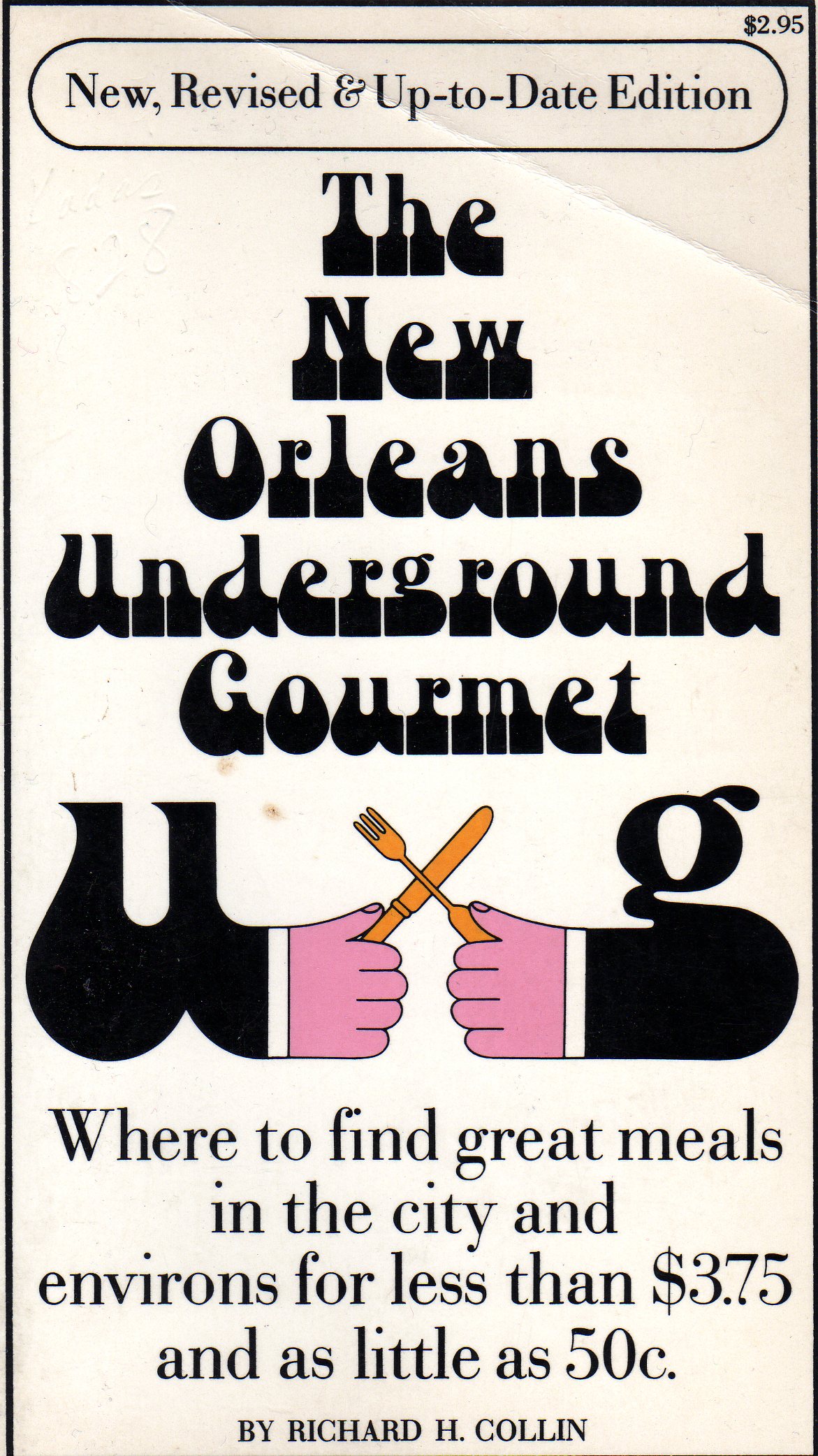
1973 Edition of The New Orleans Underground Gourmet

Many people in New Orleans would agree that Richard Collin, author of the “New Orleans Underground Gourmet” (1970, Simon and Schuster), was the city’s first real restaurant critic.  He was also a history professor at UNO, where his work in food writing was not terribly well respected, both because it was not really academic work and because it probably did not seem like appropriate behavior for a scholar.  UNO would look on such things differently today.  That said, there is a relatively clear relationship between art, film and literary criticism and scholarship in related fields, so that it does not seem unusual for professors to write analytic as well as critical pieces for both scholarly and popular publications.  The ties between academe and restaurant criticism are less obvious, at least from a disciplinary standpoint.  Especially for a historian such as Collin.

Collin stirred up quite a bit of controversy with his writing, in the various editions of “The New Orleans Underground Gourmet,” in his columns for New Orleans States-Item, and in a few other guidebooks about the city.  His reviews were subject to protest at a meeting of New Orleans restaurateurs in 1975, with accusations that he lacked objectivity and, worse, that his wife, Rima Collin (also a UNO professor), had a professional interest in seeing some restaurants better rated than others.  These kinds of accusations and debates go with the territory, as Frank Bruni, former New York Times restaurant critic, notes in his recent book “Born Round: The Secret History of a Full-Time Eater” (2009, Penguin). But the tone of the original confrontation with Collin seems to suggest that in the early 1970s, restaurateurs had not yet figured out how to make sense—and use—of restaurant writing.

However, it is also true that Collin, along with other critics in the early years of restaurant writing, did not hesitate to dole out cruel commentary on restaurants.  Although such commentary still exists, many restaurant writers in New Orleans tend these days to only write about restaurants they can say nice things about, ignoring the rest.  The reasons behind this are not entirely clear.  Perhaps they feel they can leave the harsh comments to blog writers, on-line discussion boards like Urban Spoon, Yelp, Chowhound, etc.  Collin, however, left us with some very amusing evaluations of restaurants in our neighborhood.  Some include restaurants that have since become veritable institutions in New Orleans, which suggests that despite restaurateurs fear, it is possible to survive and even thrive despite the critical barbs tossed out by food writers.  Here are a few pithy comments about defunct restaurants in our neighborhood:

On Hazel’s Po-Boy, 208 N. Carrollton (where Taqueria Guerrero Mexico is today): “Hazel’s serves cheap poor boys that lack distinction, as well as luncheon specials on paper plates.” (“The New Orleans Underground Gourmet,” 1973, p. 132.)

On Mid City Kitchen, 303 N. Carrollton (near the corner of Bienville and N. Carrollton, on the site of a defunct strip mall, unreconstructed since Katrina): “On some days this is one of the great places in town. On most days it isn’t.  Inconsistency mars the record of a brilliant Cajun burger, well seasoned hamburger poor boys, and excellent roast beef poor boys.  On the bad days you wouldn’t recognize them.” (“The New Orleans Restaurant Guide,” 1976, with Rima Collin, p. 165.)

All, of course, is not negative.  Collin waxed poetic about many restaurants.  In 1976, he wrote about Mandina’s “This is what good old New Orleans neighborhood restaurants once looked like.  Mandina’s still does.  A joy to look at and a joy to eat in.” (“The New Orleans Restaurant Guide,” 1976, with Rima Collin, p. 108).

Some evaluations change over time.  But one that stays remarkably consistent is Brocato’s, which Collin and every other critic I have come across has proclaimed magical.  He writes that the cannoli “may well be the cheapest miracle in the world.” (“The New Orleans Restaurant Guide,” 1976, with Rima Collin, p. 72.)  And despite my promise not to engage in any criticism myself, I will admit that I believe that this is still true, 34 years later.

Much can be learned from looking at the way restaurant writing has shaped our restaurants and our way of thinking about restaurants.  Please let us know of any memories you have about restaurant writing, encounters with critics or ideas about how it should be done.  Who are you favorite (and least favorite) critics?  Tell us about them.


Distinguishing Nationality and Ethnicity: The Food Factor

Where does nationality end and ethnicity begin? On the surface there seems to be an easy answer. Nationality is expressed in the form of governmental controls in which the individual pledges some type allegiance and in turn receives protections and other social services. Ethnicity on the other hand seems to supersede those limitations by including anyone who speaks a particular language, shares in origin beliefs or customs, and/or claims heritage in similar roots. Ethnicity when framed in this way seems much more inclusive.

Foods, and more particularly food ways, seem to challenge the broad sweeping inclusiveness of ethnicity. Nearly all of the restaurateurs gracing our study area seem to strive to stand out as individuals while simultaneously maintaining an adherence to the broader expectations of their potential customers.

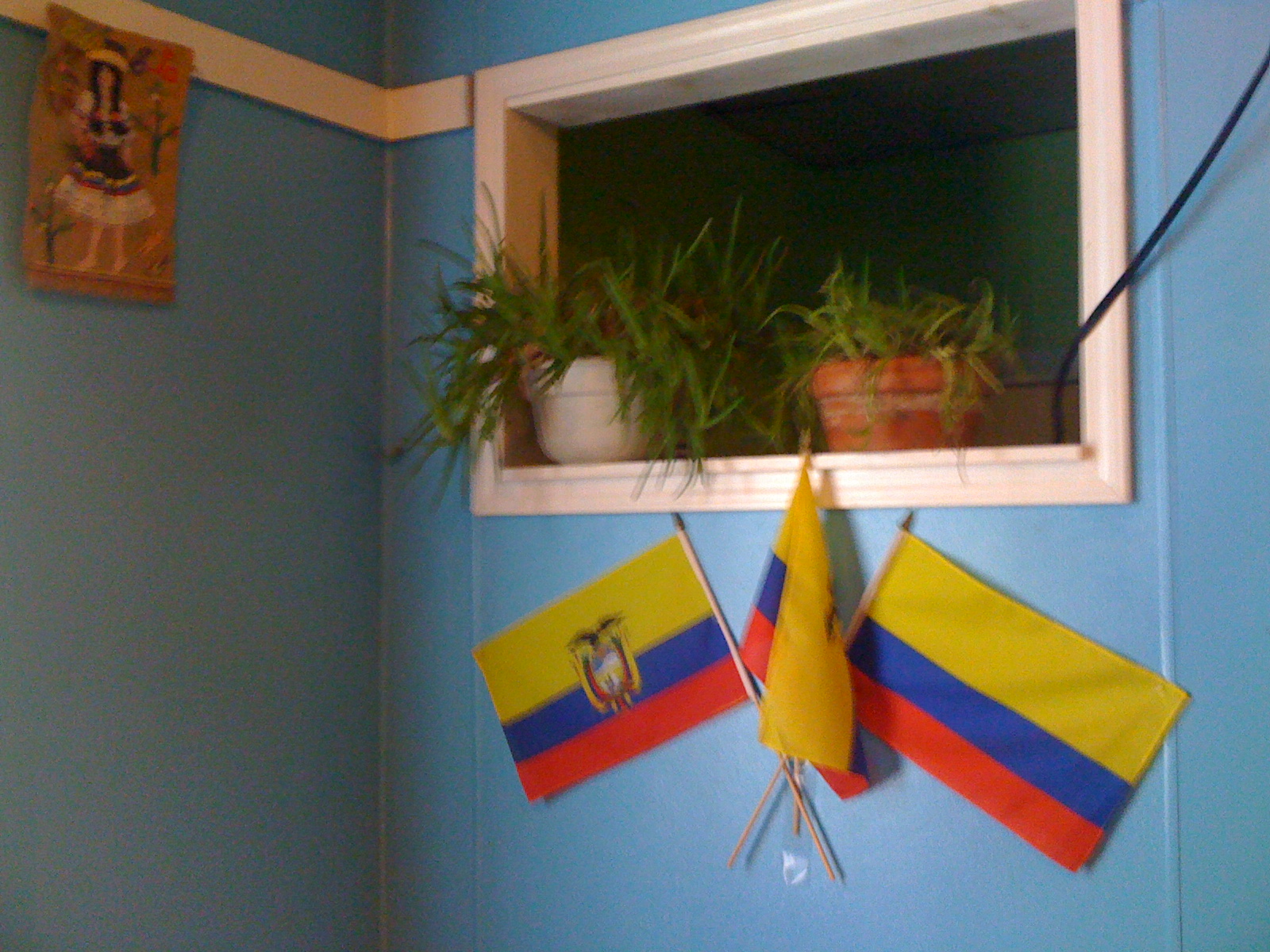
Part of the dinning decor at El Rinconsito 216 S. Carrollton Ave.

I began recalling that the meals I have eaten at El Rinconcito – Breakfast, lunch, or dinner – have all been served with soft warmed tortillas. This did not seem out of place prior to my Colombian trip– hence the lack of blog entries – where I feasted on amazing national and regional foods. None of which included even a single tortilla shell. There were close equivalents, of course, known as arepas, but their function seems closer aligned with the pita. Arepas are often stuffed with a meat, cheese, or egg, and either grilled or fried pre or post stuffing. The breakfast ones served on the coastal regions often contained fish or shrimp and were by far my absolute favorite.

Excited to share in this cuisine with my wife I quickly looked over the El Rinconcito menu when I got home and found that despite the obvious Colombian influence, the menu was lacking in the unique food stuffs I found in either urban or rural dinning. Warm tortillas now seem out of place when I go there. Despite their lack of belonging in the South American foodways, however, I do still eat every one.

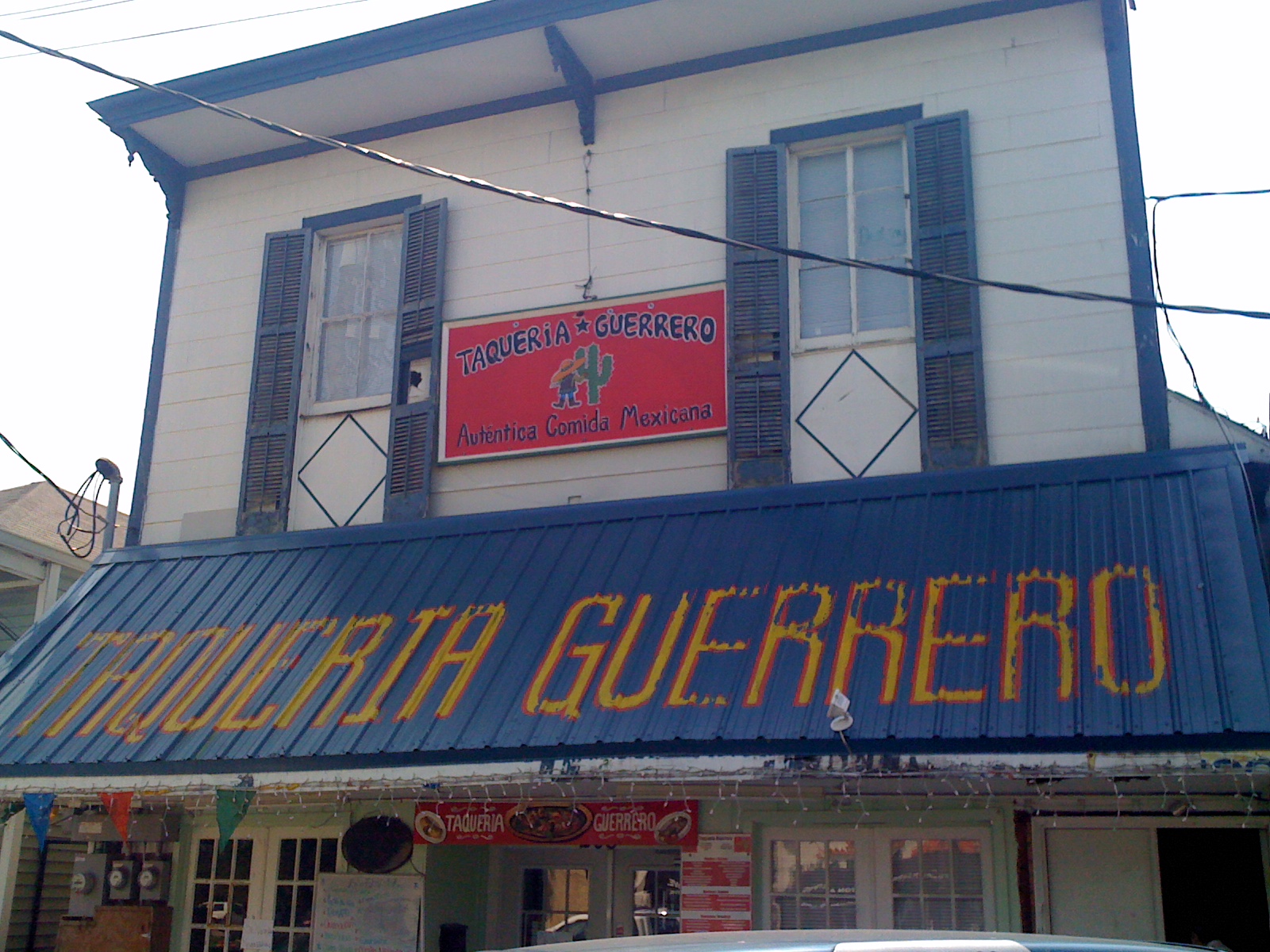
La Taqueria Guerrero at 208 S. Carrollton Ave. New Orleans

Some locations, like Taqueria Guerrero Mexico, Angelo Brocato’s Italian Ice Cream & Pastry, and soon an Italian Pie, are able to easily present national, and even regional, foods because ethnicity and nationality have become synonymous within some categories. Other places, like Theo’s Pizza, Mandina’s, and Juan’s Flying Burrito all claim a type of individuality by expressing a possessiveness over their cuisine variations. Whether the claim is to a particular lineage or place many of the restaurants in our study area claim a similar possessiveness.

Menu for Fiesta Latina of New Orleans

Among the restaurants I am currently studying –Fiesta Latina, El Rinconcito, Taqueria Guerrero, and WOW Café and Wingery – each applies differing regional ties to their menus. Fiesta Latina claims to specialize in Mexican and Central American foods, while Taqueria Guerrero offers more familiar Mexican cuisine. El Rinconcito defines itself as serving Central American and South American dishes. And WOW Café and Wingery – a Louisiana original – has sauce selections named on ethnic expectations – Asian, Bombay, and Polynesian – as well as more regionally specific selections – Texas, Acadian, and Kansas City.

What I want to know is this: what are some national and ethnic foods that you are most fond of? How do the versions of those foods stand up when exported out of their original place of consumption and creation? Do restaurants need to adopt some form of homogenization in order to be successful?

Pizza Galore

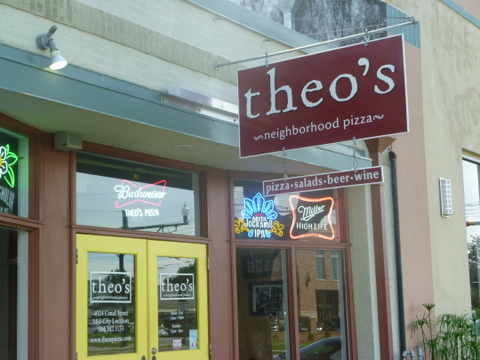
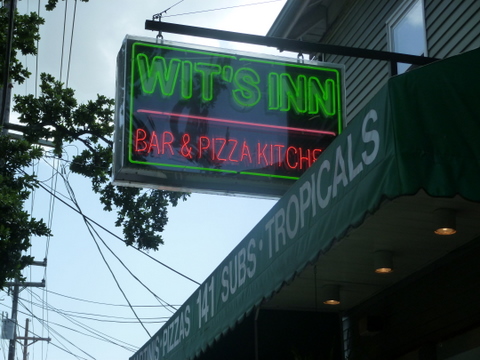
I spoke with two guys about pizza this week.  One was James “Jammer” Orintas, one of the owners of Theo’s Neighborhood Pizza, located on Canal, right near the intersection with Carrollton.  The other was Dennis Scheuermann, the owner of Wit’s Inn, which is on the corner of Carrollton and Iberville.  Both had great insights into the neighborhood and the restaurant business.  Orintas, along with his partners, is from Arkansas.  Scheuermann grew up in the 9th ward and has deep roots in New Orleans.  This contrast alone suggests that they both personify New Orleans at this point.

Both restaurants sell pizza.  I am pretty sure that their pizza pies are made in substantially different styles (I’ve eaten Theo’s pizza many times, but I have not yet tried Wit’s Inn pizza…I’ll try to make up for that soon).  Theo’s is a thin crust pizza that is often referred to as “St. Louis Style.” I have heard that Wit’s Inn pizza has a thicker, chewier kind of crust.  They both seem to have a lot of fans (I am not going to try any restaurant criticism here, so you’ll have to do your own research if you want to decide which one you like better).  Theo’s has only been in the neighborhood since mid-2009 (they have another location on Magazine Street), while Wit’s Inn has been around much longer.

Interestingly, they do not see themselves as really competing with each other.  Theo’s serves beer and wine, but is primarily, as Jammer told me, a destination for families with kids who want an affordable and relaxing night out (indeed, I can verify that the place works for that – I’ve been with my kids, other people’s kids, hordes of kids…).  Wit’s Inn has a full bar and a more diverse menu (they also do brunch on Sundays), pool tables and various electronic games-of-chance that only adults may use.  Indeed, you must be 21 to enter Wit’s Inn.  Wit’s Inn seems to be a mixture of sports bar and neighborhood hangout, with the addition of a full kitchen and professional chef.

All of which seems like a happy situation, with the potential for both businesses to thrive.  Except that they are not the only pizza purveyors in our restaurant row.  Venezia, just across Carrollton from Wit’s Inn, is famous for its pizza.  Just up the street, across the Great Divide, there are outlets for Papa John’s and Domino’s.  If you are willing to travel slightly out of our research area, down to Banks street, you will find the Crescent City Pie and Sausage Company and Lazaro’s Pizza, which is nearly a secret pizza purveyor as far as I can tell. (Just to confuse matters, the owners of Juan’s Flying Burrito, which is around the corner from Theo’s, also own Slice, another local pizzeria, but they do not have a location in the neighborhood.)  New Orleans is not a town known for pizza.  And yet, you might think we have more pizza places than po’boy shops.

And now, the Italian Pie folks are opening a new store at 125 N. Carrollton, on the same block as Fiesta Latina, Doson Noodle House and Wit’s Inn.  Italian Pie is a local chain with a fairly large number of stores across the metropolitan area.  I have no idea what the new place will look like, but I do know that their pizza is popular with many people in New Orleans.

Which raises a question: is it possible to have too much pizza in a neighborhood?  The immediate issue is one of competition and survival.  Can all of these places thrive with so many different pizza options?  There are subsidiary issues, like parking, that come to mind.  Perhaps the different kinds of pizza make these all substantially different kinds of restaurants.  Jammer pointed out that one of the things that makes the neighborhood attractive is the wide range of affordable dining choices, from various types of pizza, to different kinds of Latin American food, Italian, Chinese, Vietnamese, etc.  Do people see the pizza places as too much of the same thing or do they differentiate between them, so that each draws on their own clientele?  Does the collection of affordable restaurants bring in business for everyone?

What kind of mix of businesses, or just restaurants—succeed in neighborhoods?  How do urban planners and policy makers think about this?  There is some interesting stuff written about this—in urban planning literature, as well as in hotel, restaurant and tourism business literature (and if you have a favorite article or book to recommend, let me know!)—but take a look at this meditation on business diversity in Washington DC (part 2 is here).  It raises an interesting set of issues about restaurant and business clusters that are worth thinking about.  What has your experience been, in our restaurant row or somewhere else where restaurants congregate? Is there a pizza tipping point? Or even a point at which a neighborhood has too many restaurants?  Or maybe not enough?  And would that point be different in New Orleans, where people love eating in restaurants, than in a different city, where food is less central to the way of life?

Carrollton Avenue’s Transformation

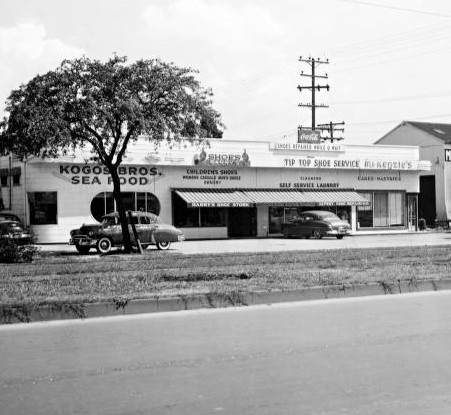
This is a photo of Carrollton's 3600 block circa 1950. Although it was taken several blocks from our research area, it is important to note that the same fate has befallen this strip of businesses as has happened on "the row" - they have since been replaced by 5 Happiness Restaurant.

When I explained to Arthur that part of my project was to map out a history of the neighborhood, he launched into a vividly detailed description of what “the row” looked like when the Brocato family moved there in 1979. The only other food establishments on the street at the time were Venezia (still standing) and Hazel’s Po-Boy’s, an establishment since closed. The Red Door Bar was also around back then, and according to Arthur its clientele isn’t as rough and tumble as it was in the old days. Everything changes with time. The rest of the street was filled with businesses that were functional for the neighborhood. On one side, (Brocato’s side) stood Fashion Forward, David’s Beauty Salon, Johnson’s Hardware, and a used car dealership where Kjean’s now stands. Across the street was Ace’s Pool hall (now Wit’s Inn), a washing machine repair center (now Doson’s), and a sign painting business. A bit further down the road towards City Park was Chaubaud’s Marine, Music City, and a tire repair shop. There was also a small market nearby where neighborhood residents could grocery shop. The building where Brocato’s itself now resides was three different bakeries beginning in the 1920’s.

It seems as though this strip of Carrollton was a sort of one-stop-shop for daily errands. When I asked Arthur what he thought of the neighborhood now in comparison to what it was back then, he told me that things have definitely changed, but he isn’t sure whether or not they’ve changed for the better. He explained that as far as a restaurant boom is concerned, he felt that “the row” had reached it’s peak right before Katrina. Restaurants in general on Carrollton Avenue have come back strong post-K, but Arthur isn’t sure that that’s best for everybody’s business. On one hand, he reasons, variety can bring people to the neighborhood more regularly to eat, but on the other, there might reach a point where there are too many establishments vying for a set group of clientele. Judging by the line out the door on a summer Friday night, I don’t think that Brocato’s has much to worry about. Nevertheless, it is fun to reminisce about spending a productive afternoon in the 70‘s on Carrollton where one could park the car and walk to get one’s hair cut, pick out a new outfit, break for a classic Italian lunch and possibly wind down by playing some pool.

Arthur’s mixed feelings about the numerous food establishments got me wondering what other residents of New Orleans and specifically Mid City think about the changes to the area. If you can recall what Carrollton was like prior to its present incarnation, please feel free to chime in and comment! I’d love to hear what pieces of history our residents have to offer.

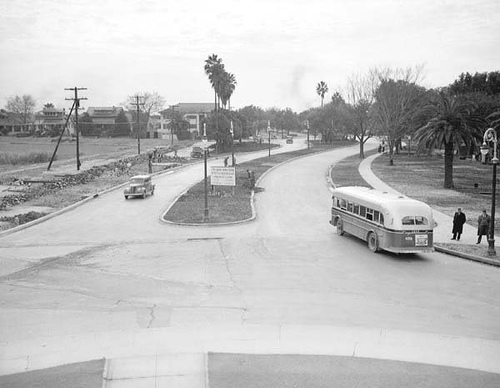
This is the intersection of Carrollton and Esplanade circa 1950. Bayou St. John is to the viewer's left and City Park is to the right.

Photos: Upper- courtesy of  www.old-new-orleans.com Lower: courtesy of www.neworleanscitypark.com

Doson Delivers

On Thursday of last week, our RRR group met for lunch at Doson Noodle House. While enjoying our meal, I noticed Mr. Ha sneak in with his briefcase. Luckily, this gave me the opportunity to catch him and arrange an interview. When I asked, he said he was free right then and there (which would have been perfect had I not forgotten my notes!) so I decided that I would wing it. Even though I was improvising, I was still able to find out a lot about the history and inner-workings of Doson Noodle House.

Mr. Ha got his first taste of the restaurant business while he was working as a busboy in San Francisco. While there, he met a chef from Shang-Hai who taught him the Chinese style of cooking. In 1978, Mr. Ha moved to New Orleans, and he has been there ever since. In 1997, he opened Chinese’s Chinese on Oak Street. The name eventually changed to Doson Noodle House before the restaurant made its move. One week before Hurricane Katrina, Doson Noodle House’s new location (135 N. Carrollton Ave.) was set to open. After Katrina struck, the restaurant had to be completely redone, yet Mr. Ha says that Doson was the first restaurant to open on N. Carrollton after the storm. He said that there were days when he would open to a line that was at least three blocks long.

When things settled down, Mr. Ha says that he noticed many of his customers from Oak Street had migrated to the new address. I asked him if he knew many of his customers by name, and he said absolutely. He then pointed to several tables in the restaurant explaining who people were, whereabouts they worked, and that many of them frequented Doson’s several times a week for lunch. He also said that I would be surprised by the amount of deliveries the restaurant makes during the week.

While talking with Mr. Ha, I also had to opportunity to take a tour of the kitchen. Everything was spotless and several cooks had their own personal stations. One lady was hand-rolling the spring rolls (which are amazing by the way!) until they looked just right. Another lady was making Pho with fresh ingredients. The walk-in freezer was humongous, and I saw the biggest wok I had ever seen. While touring, Mr. Ha informed me that most of his vegetables come from local farmers and that if he, himself, would not eat something, then he most definitely would not serve it to someone else.

Not wanting to overstay my visit, I thanked Mr. Ha for his hospitality and gave him my business card. I’ve been invited back whenever I wish, and he said next time I’m welcome to talk with some of his regulars if they’re willing. So if you’re a regular to Doson Noodle House, beware! Other photographs and more to come next week.