The Great Divide

N. Carrollton and Bienville

Every restaurant in New Orleans closed during Katrina and the subsequent floods.  As the flood waters receded, restaurants cleaned up and re-opened, each one a sign that life was returning to the city.  In fact, the return of food-related businesses (including grocery and convenience stores, gas stations, drug stores, as well as restaurants) became a kind of index that could be used to measure the city’s progress toward recovery.

But what exactly did that measure?  The question of what constituted a sign of recovery became the object of a brief, but telling controversy.  In August 2006, a year after the floods, the Louisiana Restaurant Association published a survey indicating that only 46% of the businesses in the area had been certified for reopening by state health officials.  Only 34% of food businesses in New Orleans proper were certified at that point.  This suggested that progress toward recovery was very slow.

One of the more prominent local restaurant critics, radio personality Tom Fitzmorris, wrote an open letter disputing the LRA’s numbers.  Fitzmorris argued that a meaningful measure of recovery would focus only on the restaurants that “mattered,” in determining the health of the local economy and culinary culture.  High-end restaurants in the French Quarter, he asserted, were “real” because they shaped the image of the city for both locals and tourists, while the neighborhood Chevron, selling doughnuts and hot dogs, or even Starbuck’s, did not.  The core criterion, he wrote, is that a restaurant be of “real interest to people who like to eat.”  Fitzmorris had been tracking the re-opening of the restaurants he thought mattered and, at that point in late 2006, by his measure, over 80% of the city’s restaurants had reopened.  That suggested a more vigorous recovery was underway.

It seems that Fitzmorris won that argument.  At least in New Orleans, it is unlikely that anyone would dispute that the restaurant scene is quite lively.  He continues to measure the number of restaurants open and, interestingly, he claims as of July 23, 2010 that there are 1,106 restaurants (that matter) open in the area, which is a few hundred more than were open before the 2005 disaster.  This is quite remarkable, given that a recent study, published in Nation’s Restaurant News, points out that there are actually fewer restaurants nationally now than a year ago.  We can probably assume that the NRN counts restaurants that Fitzmorris would not include, so the divide between New Orleans, with its interestingly vigorous dining scene, and the rest of the country, is probably even greater than the mere numbers show.

In fact, the national numbers suggest that independent restaurants are declining the most, while chains are doing somewhat better.  In New Orleans, it would seem—and I do not have numbers to back this up, just a sense from reading local critics and wandering around town—that the opposite is true.  We seem to have fewer chains and more local independents.  This leads me to the Great Divide in our Mid-City research area that inspired this set of observations.  There are a few dozen restaurants in the vicinity.  Most of them are independently owned and local establishments, although a couple (Juan’s, Theo’s, Fiesta Latina) are the second or third restaurant in a locally-owned group.  However, there are also a few representatives of national chains in the area, mostly at the northern edge of our study area.  These include a Subway, a Papa John’s, a Wow Café, a Domino’s Pizza and a Quiznos.  (Just for the record, Fitzmorris includes the locals with multiple shops, including those I note in this paragraph, but he does not count any of the national fast food chains mentioned here.)

On N. Carrollton

We are trying to include them in our research.  After all, they do serve food and they are quite visible.  It is unclear at this point how much we can learn.  The restaurant owners of the local establishments have been almost universally eager to join in the project.  Of course, they want to be in our planned museum exhibit and they no doubt want the publicity, but I think that they are also clearly engaged as members of the neighborhood and of the city.  This is where they live, after all.  We have had a very hard time making contact with the fast food owners and franchisees.  First, we have to track them down.  When we speak to the local shop managers, we are often (quite brusquely) informed that they cannot speak with us and that we will have to contact corporate headquarters.  Following up usually results in a parade of voice-mail menus, emails that never receive replies and, generally speaking…a vast void.  There are, of course, public records and a great deal of data we can incorporate.  We have photographic evidence they exist, as you can clearly see.  We do not know yet whether or not these establishments want to be seen as part of the community.  We have not (yet) included them in the web site list on the right of this page, precisely because they do not have local sites that we can find, only national ones.

The divide between the local and the national chain seems, in this case, to be rather sharp.  Yet these shops clearly employ local residents and serve local customers.  They are right there, in the community.  We are not ready to count them out.  In fact, we are still determined to include them in our research.  Any advice on how to do that would be welcome!
Eating Your Feelings

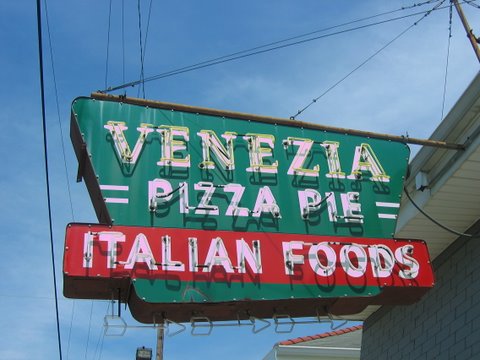
When I told a friend about the restaurants that would be the focus of our project, she lit up at the mention of Mandina’s.  This is where her family has always gone immediately following the funeral of a relative.  In fact, she told me, members of her family have become so accustomed to the ritual of post-funeral dining, that many of them now make a point to eat at Mandina’s after any funeral – family or otherwise.  Eating one’s way through a difficult time seems to be characteristic of many New Orleanians – evidenced in the aftermath of the 2005 storms, when local papers and the Mid-City Neighborhood Organization posted almost daily updates on the projected reopening dates of the beloved Restaurant Row ; as if residents couldn’t wait to eat away troubled thoughts at Brocato’s or Venezia and be assured that all would be well  because the restaurants were back.

Now, most of them are back and we are trying to establish what it is about them specifically that has so endeared them to the community.  Why are these businesses flourishing and in such concentration?  “Zoning,” was the response  David Beriss got from a restaurant affiliate to this question – an answer a bit deflating for a few moments for us, who are hoping for something more curious and charming than zoning to explain the vibrant area.  I gave this some thought, deciding that location in the row alone was not a guarantee of success for a food establishment.  Our research team is now collecting stories of the early years of business for the restaurants as told by owners, employees, and customers.  So far I am most impressed by the adaptivity of the establishments.  One restaurateur told me she had to change her menu completely three times within the first months of opening earlier this year.  She and her patrons are still trying to agree on what her restaurant should serve.  Anthony of Venezia said that his restaurant used to be open till all hours for pitchers of beer and pizza.  At that time they were drawing in a student crowd.  Now he said they mostly do large parties and family gatherings.  Maybe I should recommend my friend check out Venezia as another great after-death meal spot.

Welcome to the Restaurant Row Recovery Project

New Orleans is a restaurant town.  Tourists who come here know that, of course.  In fact, restaurant owners say that people often come for the music and leave talking about dinner.  Yet one of the things that makes the city’s restaurant obsession distinctive is that it exists at least as much for locals as it does for visitors.  There are bistros and neighborhood joints everywhere, it seems, often in places where tourists never tread.  You can get a great po’boy or have a wonderful plate of seafood in nearly any neighborhood in the city.  These are mostly local restaurants, not the casual dining and fast food chains that define eating out in much of the United States.  In an era of increasingly homogenized dining, New Orleans’ restaurant obsession—and the broader culinary culture of which it is a part—seems like an anomaly.

We want to figure out what makes it work.

Based in the Department of Anthropology at the University of New Orleans, we are a team of researchers (1 faculty member and 4 intrepid undergraduates) trying to understand the links between a collection of restaurants, the surrounding neighborhood, and the distinctive culture of New Orleans.

The neighborhood is called Mid-City, a mixed-income, ethnically diverse part of New Orleans full of interesting people and an amazing array of architecture.  We are specifically focused on the restaurant row that runs roughly from the Little Tokyo at the corner of Bienville and N. Carrollton down to Juan’s Flying Burrito near the corner of Carrollton and Canal, while taking a little detour down Canal toward Mandina‘s and The Ruby Slipper, in one direction, and toward Café Minh in the other.  This takes in nearly two dozen eating establishments…a fascinating collection of dining opportunities and small businesses (if we pushed the geographical limits a bit more, we could bring in several other restaurants, but we only have so much time).

The area has long been characterized by a significant cluster of restaurants and bars.  Some have been there for a long time (Mandina’s has been a restaurant since 1932 and the family has had a business in the spot since 1898), while others are very new (Yummy Yummy Chinese Restaurant opened in 2009).  Even before the 2005 floods devastated the neighborhood, the restaurants were a diverse bunch, including both old-line Creole Italian restaurants, sushi, French haute cuisine, fast food and a famous purveyor of tamales (Manuel’s, now departed).  Many of the old restaurants are still there and they seem to be thriving.  There are also new restaurants that reflect the city’s changing demographics, including three Latino restaurants, a Vietnamese restaurant (with a Chinese history), and others.

When the floods cleared, the recovery began and the restaurant cluster seemed to lead the neighborhood in rebuilding.  Angelo Brocato’s Ice Cream and Confectionary was one of the first to reopen in the area, in September 2006, 13 months after the storm and 101 years since they first opened in the French Quarter.  It seemed like the businesses came back, renovated and reopened even before many of the people in the area came back.  There is still a shuttered strip mall, which once housed a Chinese restaurant, a daiquiri shop and a few other businesses, as evidence of the destruction.  But there is also much that is new.

This is where we are conducting our research.  We are out there interviewing restaurant owners, managers, cooks, waiters and busboys.  We want to know their stories and the stories of their businesses.  We are researching the history of the area, trying to determine when the cluster developed, what facilitated it, and what sustains it.  We are taking pictures, making videos, writing notes and collecting artifacts.   This blog will serve to showcase our intermediate findings, our thoughts, questions and insights.  We’ll put up a picture or two.  Maybe we will make you hungry enough to go out to eat at one of these restaurants (careful, many of them are packed at lunch and dinner already!).

We think that this restaurant cluster is a key part of New Orleans culinary culture.  Our results will show how the restaurants are connected to the neighborhood, the city and to what makes this place distinctive.  We are working with the Southern Food and Beverage Museum to put together two exhibits (one on-line, the other on-site) in the fall that will showcase our findings.  And, of course, we will endeavor to write-up and publish our results.  There will be much to say!

Posted by David Beriss