The Restaurant Row Blog Returns!

Post by David Beriss

The blog is back! In case any of our loyal readers were wondering, work on the Restaurant Row Project was put on hold at the beginning of the 2010-11 academic year, as the valiant team of researchers was swept back into the challenges of daily life in the university. Of the team’s student members, two have subsequently gone on to graduate and pursue other careers, while the other two are nearing graduation and promising futures at this time.

Which leaves me, the professor and organizer. I remain bothered and frustrated by the unfinished nature of our work. What do we really know about this restaurant row? Why is it here? Are there patterns that we can see in the way it has evolved over time? What challenges do restaurateurs face in this neighborhood? I had always hoped to bring the project to some conclusion. I want to be able to show some insights into how our restaurant row is connected to the city itself. I think the way it has evolved can tell us something about where New Orleans has been and where it is headed.

It turns out, even without my initial crack team of eager researchers, I have some very useful resources. I frequently teach classes in applied urban anthropology, full of more sharp-eyed students, ready to ask good questions, observe the details of life, spend hours in musty archives and sift through data. I am teaching one of those classes right now, in fact, and have engaged my students as a new research team. They will build on the excellent work of the original crew over the course of this semester. Divided into pairs, they have already begun to collect data and make observations. They will begin blogging in this space regularly over the next week. Over the course of the semester, they will be delivering their fieldnotes to me regularly. At the end of the term, each team will make a presentation of their findings and deliver a report on their work. Perhaps most significantly, they will each produce a poster, combining texts and images that can be used to frame exhibits about the restaurant row.

When we last checked, the restaurants in our neighborhood had largely recovered from the 2005 floods and were beginning to deal with the BP oil spills’ impact on their menus, customers, and future. We will explore the consequences of that ongoing disaster on the restaurants.

Other changes have occurred as well. There are new restaurants in the area—Redemption, the Canal St. Bistro, Katie’s, Blue Dot Donuts, Italian Pie, Rue 127, Juicy Lucy’s—that make the area even more of an eating destination. As alert readers may note, these are not all exactly new. A few are rebirths of pre-2005 restaurants that had not happened yet when we were last in the field. Others are new locations for New Orleans local chains. Each has a story that we hope we will be able to tell.

The neighborhood is also facing a significant new challenge. One of the last parts of the restaurant row that remained undeveloped following the 2005 floods—the area of Carrollton avenue between Bienville and St. Louis—is now slated for redevelopment. A supermarket, a variety of local retail and a few national chain restaurants are expected to move into the space. Work, it seems, will begin shortly. This coincides with the impending development of a greenway that will link the neighborhood with the French Quarter. All of this will make for an interesting future for our restaurant row.

The applied anthropology research team will complete our initial project, helping us understand the social and cultural processes that frame this particular restaurant row. In addition, their work will help us establish a cultural baseline for understanding subsequent changes in the area. There is no doubt that the neighborhood will continue to reflect processes at work in the broader city. I hope that my students are able to shed light on where those processes are taking us.

Blogosphere Realizations of a Noobie Blogger

As some of you already know, an on-site (and online) exhibit at the Southern Food and Beverage Museum is going to accompany our Restaurant Row Recovery Project. We are working on the possibility of publications in scholarly journals as well. All of this seemed relatively standard for this type of project, but as to how blogging fit into this, I was clueless.

Rising Tide NOLA 5 New Media Conference Poster. Graphic Art by Greg Peters of Suspect Device (click the photo for a link to more of Greg's work)

On August 28th I discovered that we had at our disposal an entirely new media format for our project to tap into: blogging. I know this sounds odd since we have been blogging about our project for weeks now, but I never really understood the potential of such an avenue until I attended the 5th annual Rising Tide NOLA New Media Conference. Until that rainy Saturday I thought of our blog as simply a method of providing some chronological feedback on our progress, and as a possible source of topics for further exploration.

Prior to this project I was not a blogger. Until this conference I never truly understood the power, and access, blogging could provide. The new media conference (subtitled A Conference on the Future of New Orleans) changed that.

What I am somewhat familiar with is the jambalaya of emotions that go along with doing field work in New Orleans. Self doubt gets sautéed with shyness and preemptive humiliation to create the perfect discomfort food, and I had a feast before me. What did come as a surprise were the jitters I had about making our project public. The bloggers I met at the conference seemed immune to such thing. In fact, they actively strive to be public.

At this point in my life all of the conclusions and analysis of my previous work remained in a closed academic system, thus lessening potential shortfall fears. The final outcome resulted in grades in a grade book, some brief experiences and encounters with the public, and a new semester of classes. In other words, no harm, no foul. But this project is different; this project is not just for a grade. This project is for adding to the knowledge base of Anthropology, for shedding more light on the role restaurants play in New Orleans culture, and for contributing to the understanding of a New Orleans post Katrina neighborhood recovery. All of this sounds fantastic on paper (and in theory), but how can it become practical? How do we add our findings to the elusive knowledge base? How does our research, and academic fantasizing, make the way from bits of collected data to printed literature and disciplinary journals to public knowledge and discourse?

The bloggers and conference attendees– active and aware citizens – are providing us an alternative answer: new media. Part of the same media some the restaurants on our Row use to tell their own stories (a topic covered on this blog by David Beriss). Key note speaker Mac McClelland of MotherJones.com and author of For Us, Surrender Is Out Of The Question: A Story From Burma’s Never-Ending War, went so far as to say that the rise of “citizen journalist” was evidence that new media was a forerunner to pushing for cultural change and cultural awareness. I came away from this event in agreement.

Keynote spearker Mac McClelland. Photo by Bart "Editor B" Everson of b. rox (click the photo for a link to more of Editor B's work)

McClelland also spoke against the recent government, and BP, reports on the amount of oil still present in the Gulf. She argued the oil is not gone and that the seafood and restaurant industry are going to be reeling from this for a long time, a sentiment echoed by two of the restaurant owners I have interviewed. McClelland praised the blogging community of New Orleans for its dedication and passion for the city. The New Orleans blogosphere (and now us, the RRR team, to a lesser extent) are creating transparency and focus to a city in recovery.

Taking this one step further it is now apparent to me that new media can be tremendously useful for future academic recovery projects like this one. Gone are the days of the lonely anthropologist heading off to some far away exotic locale with a notebook and pencil. Technological advances like new media allow us to not only document our ongoing work, but also to achieve a level of transparency previously unattainable. Analysis and conclusions can be viewed as a process instead of an event. Consultation can come from a variety of far away sources, and perhaps most importantly, our study subjects can be involved like never before.

New media is a powerful tool. I am honored to have been invited to the conference, and am inspired to further utilize this avenue for my future anthropological and social justice work. I would like to say thank you to all those who continue to provide the community with an alternative voice.

Exploring Their Connections

One of the objectives of our Restaurant Row Recovery Project is to try to better understand how restaurants have played a role, if any, in the relationships with, and within, the neighborhood and the Greater New Orleans area.

Obviously, as businesses, they compete to provide a service in exchange for an established price. From the other side, the consumer provides the restaurant owner and his employees a means of financial support. Bottom line is that these are businesses, and profitability is fundamental to their survival. But these local establishments seem almost as dependent upon their relationships as their bottom line. After interviewing some of the owners, employees, and customers of the Row it quickly became apparent that there was much more to this story.

For starters, most of the restaurant owners interviewed by my colleagues and I have described a type of local connection fundamental to their supply chain. Some, like the owner of EcoCafe, actively engage in more grass roots community networking, by striving to buy from local farmer’s markets as much as is absolutely possible. Others like, Paul Ballard, founder and CEO of WOW Café and Wingery, as well as PJ’s Coffee, are supplied by larger firms, but are nonetheless local. Frank, owner of Rinconcito, went so far as to express a sense of loss when he mentioned decreasing his seafood order from local supplier Vincent Piazza, Jr. & Sons Seafood Incorporated due to the BP oil spew plunging the demand for seafood. These all serve as examples of restaurants playing the role of consumer and local patron, but also express how each strives to maintain a connection to place.

Afternoon Delivery

The bartender and daughter of Delmy Cruz, owner of Fiesta Latina, echoed what Paul had said about being there not just to make money, but to serve a community in need. This got me thinking about what we, as consumers, need to have in a restaurant relationship. What is it we expect to get out of a restaurant beyond a quality meal? How are those expectations met? I know I enjoy going to the places where I know the staff. Making a connection to the people who work in my favorite haunts is fundamental to it actually becoming one of my favorites.

Paul talked about his amazement with the response to first opening after the storm. He said he had never heard so many heartfelt thank you’s in his life. He recalls seeing people piling their MREs (Meals-Ready-to-Eat distributed by the military in the wake of Katrina) on the table while they ordered their first familiar meal in weeks. Paul says he will always remember how happy people were to be in one place eating wings of all things. To them, the folks at WOW were heroes. They brought back something familiar. They brought back a little bit of normality and Americana: beer, wings, and college football.

Above all, these examples go to show how restaurants can often play a much larger role in the neighborhood beyond providing substance to an already nourished population base.  They can serve as counselors, organizers, entertainers, neighbors, and sometimes friends.  Of course, for our study group it doesn’t hurt to have a tasty baseline from which one can operate.

Telling Their Own Story

I will start with the obvious: chefs and restaurants are trendy.  Above all, chefs in fancy white tablecloth restaurants have become important players in the making of the symbolic economy (that is the one in which you buy things—a sports car, a zucchini, a house, shoes—because it means something to you, not just because you need it).  Eating in their restaurants, reading and watching their interviews and TV shows and buying their cookbooks and other products are all part of the process by which we consumers make ourselves into the kind of people we think we want to be.  Through all of the media they create, these restaurateurs tell their own stories and make themselves into who we think they are…and help give meaning to our own dining and cooking experiences.

The process through which some of the more savvy chefs define themselves is fascinating to watch.  One of the difficulties faced by social scientists who want to study restaurateurs is precisely that they are great at telling their own stories.  They are good at connecting with the desires and ideas that permeate our societies.  The stories of chefs’ lives, of the highs and lows of kitchen life, of the creative process in the restaurant, of difficult customers or unusual settings to prepare a meal all help create a kind of template that the rest of us can use to frame our lives, culinary or otherwise.

There are no famous chefs or media stars in our Mid-City restaurant cluster.  But there are stories to tell, as we have already documented here.  Perhaps more importantly, the restaurateurs are, in many cases, already telling their own stories.  They use web pages and social media, along with more traditional media, to create this narrative.  Restaurants like Mandina’s and Brocato‘s have quite elaborate web sites, outlining their histories, including pre and post Katrina events, details about rebuilding and links to outside writing or video about them.  Of course, they also include menus, addresses and hours as well as contact information.  Not all the neighborhood restaurants have web sites (we list those that do on the right side of the blog) and not all of them have extensive information.  Some of the restaurants also have Facebook pages and some may also use other social media as well.  I am linked to several of them in this way and mostly get regular—and mouthwatering—reports of daily specials.

Still, the media are there and the restaurants are beginning to employ them to do more than simply announce specials.  They are using them to tell their stories and thus shape the way we think about them.  This is rapidly becoming an important part of how we can think about forces shaping the neighborhood and city.  The manner in which the restaurant owners represent themselves through their web sites and social media shapes our knowledge about them and will eventually help contour our understanding of the neighborhood beyond their doors.  All of this raises a lot of questions: why do some restaurants pursue this while others do not?  (In our study, restaurants catering to recent immigrant populations seem less likely to have extensive web sites, for example.)  Who reads the sites and what do they take away from that?  As restaurants reach out in this way, are they fundamentally changing the dining experience?

The fact that the people we are studying are telling their own stories through these public representations raises another set of issues as well.  What kinds of insights do anthropologists (or other social scientists) have that might be different from or complementary to information presented by the restaurants themselves?  If we are going to make our work useful, we have to be able to put the restaurant stories into a broader context.  We have to show how the restaurants in our cluster fit into and shape the contours of the city’s broader culture and history.  As the summer winds down and we start to look closely at our data, we will be concentrating on this.  The restaurateurs continue to tell us their stories, both directly and through their public representations.  Our job is to put this together and see if something emerges that gives us new ideas about restaurant clusters, neighborhoods, Mid-City and New Orleans.  Stay tuned!

Minh-City Cafe

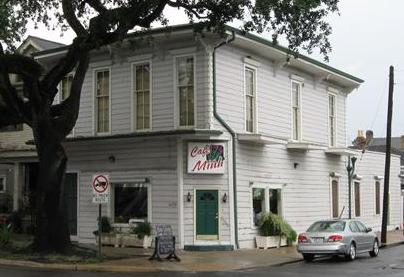
One of my research adventures took place at Cafe Minh. It is located in what used to be Michael’s Mid-City Grill before the storm. When the latter restaurant did not re-open Post-Katrina, Chef Minh Bui decided that it would be a fitting abode for his Cafe Minh.

With his roots in Vietnam, Chef Minh got his New Orleans start cooking at places such as Emeril’s and Commander’s Palace. After mastering his skills, he developed a Vietnamese-French fusion cuisine that contains hints of local Creole cooking. His first restaurant Lemongrass was opened next to Angelo Brocato’s on Carrollton Avenue. A second location of Lemongrass located in the International House hotel was opened, and a third restaurant called 56 Degrees was also opened in the Whitney Hotel. Before Katrina, both the Carrollton location and 56 Degrees closed. After the storm, Chef Minh decided he wanted to return to Mid-City and opened Cafe Minh at its current location.

Cafe Minh fits perfectly in the Restaurant Row even though it is not physically in line with the others. About a block into Canal Street, it is still in close walking distance of the area, however. One thing we can recognize about the Restaurant Row is that even though there may be similar types of food (for instance, Wit’s Inn, Venezia, Theo’s, Papa John’s and Domino’s all have pizza), there is still enough variety throughout the restaurants that they are all able to survive. Among the Asian restaurants, you may find that Little Tokyo, Doson’s Noodle House, Yummy Yummy, and even Cafe Minh have similar items on the menu. Yet because of the creativity of the chefs, the different environments of the restaurants themselves, and the specific cravings of those searching out food, co-existing is not a problem for these places.

Another similarity I have noticed between the Asian restaurants is that the owners or head chefs all learned to cook in their birth countries. This seems to come full circle as they originally learn to cook in the authentic way of their birthplace, then they end up drifting into another type of cuisine (whether it be another Asian cuisine or something completely different), and in the end, they come back to their original style of cooking, adding a bit of their own flair. That little bit of flair and originality is what sets each of these restaurants apart from the other.

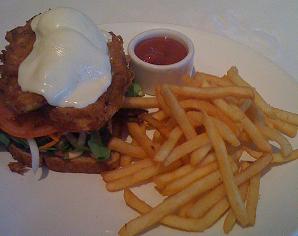
During my visit, I discovered that the food at Cafe Minh is excellent, however, when one typically thinks of the item he or she is ordering, one might not get exactly what they are expecting. For instance, when I ordered the fried eggplant, I did not expect it to be topped with mozzarella, on top of tomatoes, on top of a bed of lettuce, on top of toast. It was amazing nonetheless. This is an example of Chef Minh’s genius at work.

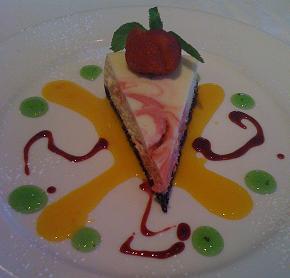
For dessert I had the white chocolate raspberry cheesecake, and it was divine. Colorful and divine.

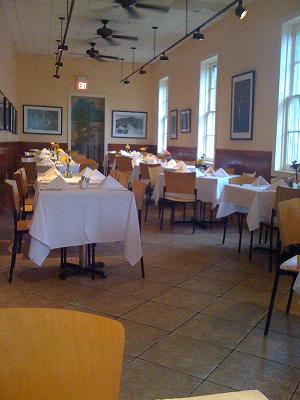
Also, while visiting Cafe Minh, I immediately noticed all of the artwork on the walls. With the high ceilings and ambient lighting, I almost felt that I was in an art gallery for a moment. The bartender even told me that the artwork is rotated by several local artists throughout the year.

When wandering Mid-City and you find yourself wanting something different than the norm, try stopping by Cafe Minh. If anything, the experience is one you’re unlikely to find anywhere else on Restaurant Row.

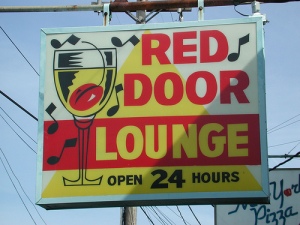
The Red Door Lounge

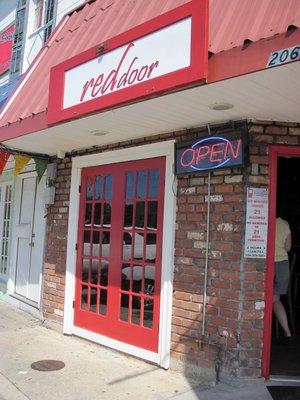
The Red Door Lounge is described to me as having “Mid-City charm.”  Online reviews, as well as the bar’s homepage, consistently use the same adjective.  The bar’s bio states that it is “a cozy place for regulars and an inviting space for newcomers.” Not being overly familiar with Mid-City, I wanted  to see what about the bar gave it such obvious Mid-City charm.  Then I hoped to discover what Mid-City charm even meant – the term seems to be used and understood by locals with some frequency, as if there were a particular qualifying criteria for such a description.  

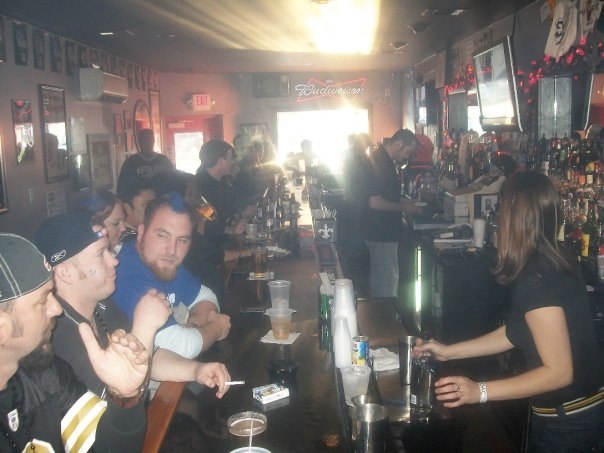
The front door of the bar is angled in such a way that if viewed in isolation, it would appear to be a corner lot. However, it is not.  It is positioned between Taqueria Guerrero and a discount mattress and futon store.  Charming.  Inside it is narrow, long, dark, and last night, hot; the air conditioning had gone out earlier that day.  The walls are lined with a mix of (reproduction?) nostalgia, Saints stuff, some acrylic art, photos from the flood, and bar events promotion boards.  There will be free food for next weekend’s Saint’s game.  The Red Door also offers a variety of activities, other than drinking.  One can gamble using video poker machines, play Wii, darts, pool, or watch TV.  It also appears that you could have a dance party.  There is a disco ball all the way in back by the pool table.

The crowd seemed almost entirely regulars and many service industry workers. This could be in part because the Red Door offers a discount for industry people.  The bartender was very friendly and the drinks were extremely cheap.  Though I did not order a $10 bucket of beer or a $5 pitcher, if I had it would have been served with a bag of ice floating to maintain drinking temperature.

The Red Door during a Saint's game

I understand that the bar was originally opened in 1940, but after Katrina, was bought and renovated by its current owner.  I have come across reviewers that long for the old Red Door, saying that the new one is “straight out of suburbia.” There are others, though, that feel it is the “perfect neighborhood bar.”  One such blogger goes so far as the have specific requirements for earning this title, requirements worth reading as they paint a vivid picture of the Red Door – http://millyonair.wordpress.com/2009/02/24/new-orleans-part-iii-the-red-door/ .  Despite the heat and the 90’s pop grunge playing last night (later changed to Erykah Badu, which was great) and the sports-bar-feel of the Red Door, I was charmed.  There was an odd assortment of effects that did this; street car going by, holiday string lights, the fact that the bar decorum makes it seem as if they are always hosting a party, and that Restaurant Row and the Red Door Lounge have a slightly dilapidated look and feel to them.  It feels like a neighborhood here, maybe that is “Mid-City charm.”.

Paul Ballard, A New Orleans Inspired Wingman

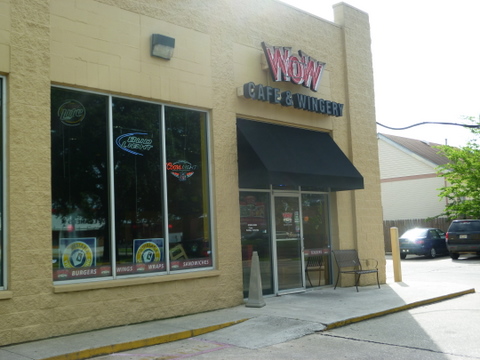
Wow!

This past week I had the opportunity to sit down with Mr. Paul Ballard, president and CEO of WOW Café and Wingery. Mr. Ballard is a larger than life kind of man with a captivating grin and a presence that leaves listeners hanging on his every word. His strong family ties and love for all things New Orleans were evident within the first several minutes of our encounter. We were just sitting down at a table overlooking a rainy Orleans avenue sipping cold brewed coffee when Mr. Ballard first surprised me by immediately thanking me for our interest in his company. For the first time in a long while I did not feel as though I were pestering someone who had more important work to do than indulge the curiosities of a budding young anthropologist. It was also about this time that I learned Paul was a title that Mr. Ballard was more comfortable with.

Paul is a first generation New Orleanian, who grew up in a music store, Tape City USA, owned by his parents. They operated locations in Metairie, the CBD, and on Carrollton Avenue. Paul said it was a big day for them when then franchisee Nancy Bounds opened the Mid City location. “It was exciting for us to be back in the neighborhood”, Paul said with a smile. This excitement, he later claims, was one of the main reasons he and his brothers, also his partners in WOW, thought it was important to get back open after the storm.

Paul graduated from Tulane University with a degree in History and an intention of going on to Law School. It was while he was attending Tulane he met his wife, and future mother of his 4 children (the youngest only a matter of weeks old). Like many of New Orleans’ college students he found work at several bars and restaurants around town. Sal & Sam’s, which he defined as New Orleans Italian fine dining, required he wear a tuxedo and understand the importance of a good sauce, a notion that stuck with him as the WOW franchise began to grow.

Paul also recounted his experiences as a bartender at Rosie’s Big Easy on Tchoupitoulas. “Having been around for the progression from 4 track and 8 track players to LPs and so on, working at Rosie’s, just down from Tipitina’s, was a blast. We grew up around the music”. He went on to say how he feels very connected to New Orleans culture. He spent parts of his childhood all over this city, and says that when he sees a WOW in some of his old stomping grounds he cannot help but feel good.

Paul’s narrative is a great example of how culture reshapes itself. He grew up part of New Orleans music and food scene. Now he and his wife are raising their own children in an entrepreneurial environment. They are exposing them to an avenue that is clearly one of the cornerstones of New Orleans identity: food. Hot wings and beer may not be the first thing you think of when you think New Orleans food, but the Ballard family has dedicated themselves to creating and spreading representations of New Orleans. I will explore more of this next week when I discuss the connections that Paul has established over the years including his links to PJ’s Coffee founder Phyllis Jordan, and Chefs George Rhode and Paul Purdhomme.

Care for a Drink

I was recently discussing the subject of booze with a friend, a topic most people know at least a little about, or at the very least have an opinion on.  He felt many people seem to have a negative view of booze in general.  This friend, as you may have guessed, is not from New Orleans.  I tried explaining to him drinking here is different.  I argued that in a place like New Orleans drinking, like eating, is a special thing and does not carry the same stigma as it may elsewhere.

Needless to say the conversation got me thinking about alcohol and New Orleans foodways.   There is a discernible booze focus in some areas of our fair city– Bourbon Street comes quickly to mind, as does drinking and parading which goes hand-in-hand for many Carnival attendees.  But outside of that where does booze fit into our perceptions of New Orleans foodways?  Does drinking in general have the same assumed negative connotation in New Orleans as it does in other parts of the country?  Is the stigma (if one exists) lessened when alcohol is consumed with a meal?  Does dining at a restaurant provide a positive opportunity to have a cocktail that is absent from home meals?

Many restaurants look to bar sales to improve their profitability.  Some places focus on alcohol sales to the point where food seems like the compliment.  WOW Café and Wingery is one such place where I believe drinking a beer at noon is acceptable because it was paired with a food that, to me, requires a crisp beverage.  Another place I learned a lunchtime draft is acceptable came during our group meeting at Theo’s Pizza, where again I found the food offerings to be complete when paired with a pint.

La Taqueria Geurrero is the only restaurant I am studying that did not have hooch on hand.  They will, however, hop over to The Red Door – a full service bar discussed more by our very own jyocom– to procure anything you may like.  The lack of bar facilities makes them unique amongst the restaurants I am studying.  Rinconcito, Fiesta Latina, Wow Café and Wingery, and The Carrollton all offer (or offered in the case of The Carrollton) full bar service.

Fiesta Latina is laid out in such a way that the bar area is elevated about 3 ½ feet above the dining area.   This provides some semblance of separation between bar and restaurant, but not much.  The separation in WOW Café and Wingery is nonexistent.  The bar is between the dining area and a large pass-through window that exposes several hard working cooks to the awaiting customers.

This is almost the exact opposite of Rinconcito.  Their bar room is large and stretches the entire length of the property front.  The dining area is situated in the rear of the building, and is separated almost completely from the bar by a moderately sized room that houses the pool table.  This layout almost makes it seem as though going from one room to the next is like going to a different place.

Feel free to share your own food, drink, and event pairings.  We would love to know what you are eating and drinking and how they go together with whatever you enjoy doing, especially if it involves the Mid City Restaurant Row!

Restaurant Criticism

I wrote recently that I would not engage in any restaurant criticism here.  And I won’t.  But an essential part of our research is figuring out where the restaurants—past and present—of our restaurant row fit within the complex New Orleans culinary universe.  To that end, I have spent many hours lately digging around in old newspapers, magazines, guidebooks, newsletters, etc. to see how the restaurants have been evaluated over time.

Since the late 1960s, restaurant critics have played an important role in shaping discussions about restaurants and dining in New Orleans.  For this project, I am looking mostly at material about our neighborhood, written and published locally.  This is simply a way of making a very large amount of material more manageable.  For another project, I am also looking into restaurant writing about New Orleans more generally, including some of the early efforts to legitimize the genre and the way it has changed over time, as the idea of culture, useful criticism, careers and other factors have come into focus.

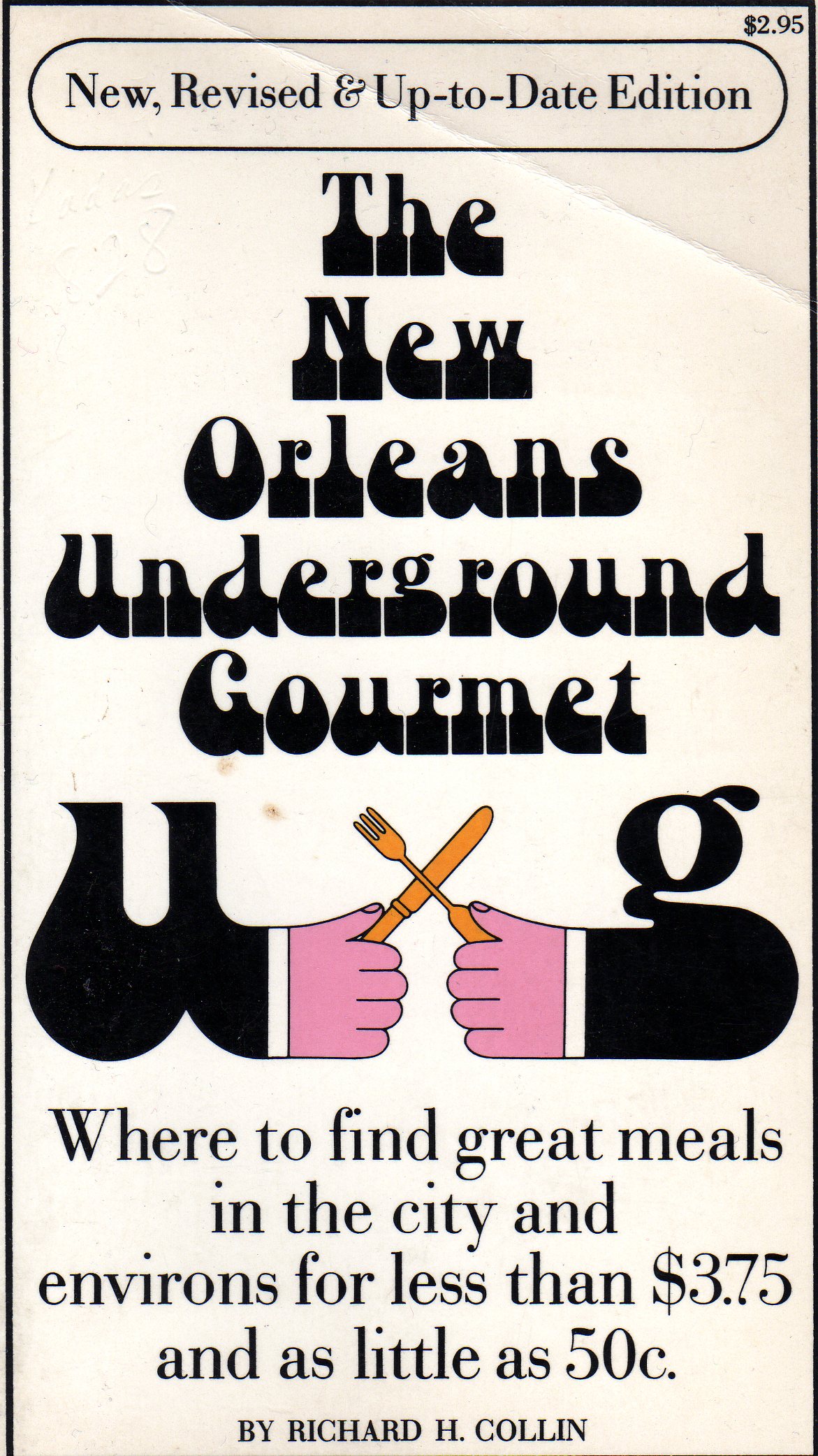
1973 Edition of The New Orleans Underground Gourmet

Many people in New Orleans would agree that Richard Collin, author of the “New Orleans Underground Gourmet” (1970, Simon and Schuster), was the city’s first real restaurant critic.  He was also a history professor at UNO, where his work in food writing was not terribly well respected, both because it was not really academic work and because it probably did not seem like appropriate behavior for a scholar.  UNO would look on such things differently today.  That said, there is a relatively clear relationship between art, film and literary criticism and scholarship in related fields, so that it does not seem unusual for professors to write analytic as well as critical pieces for both scholarly and popular publications.  The ties between academe and restaurant criticism are less obvious, at least from a disciplinary standpoint.  Especially for a historian such as Collin.

Collin stirred up quite a bit of controversy with his writing, in the various editions of “The New Orleans Underground Gourmet,” in his columns for New Orleans States-Item, and in a few other guidebooks about the city.  His reviews were subject to protest at a meeting of New Orleans restaurateurs in 1975, with accusations that he lacked objectivity and, worse, that his wife, Rima Collin (also a UNO professor), had a professional interest in seeing some restaurants better rated than others.  These kinds of accusations and debates go with the territory, as Frank Bruni, former New York Times restaurant critic, notes in his recent book “Born Round: The Secret History of a Full-Time Eater” (2009, Penguin). But the tone of the original confrontation with Collin seems to suggest that in the early 1970s, restaurateurs had not yet figured out how to make sense—and use—of restaurant writing.

However, it is also true that Collin, along with other critics in the early years of restaurant writing, did not hesitate to dole out cruel commentary on restaurants.  Although such commentary still exists, many restaurant writers in New Orleans tend these days to only write about restaurants they can say nice things about, ignoring the rest.  The reasons behind this are not entirely clear.  Perhaps they feel they can leave the harsh comments to blog writers, on-line discussion boards like Urban Spoon, Yelp, Chowhound, etc.  Collin, however, left us with some very amusing evaluations of restaurants in our neighborhood.  Some include restaurants that have since become veritable institutions in New Orleans, which suggests that despite restaurateurs fear, it is possible to survive and even thrive despite the critical barbs tossed out by food writers.  Here are a few pithy comments about defunct restaurants in our neighborhood:

On Hazel’s Po-Boy, 208 N. Carrollton (where Taqueria Guerrero Mexico is today): “Hazel’s serves cheap poor boys that lack distinction, as well as luncheon specials on paper plates.” (“The New Orleans Underground Gourmet,” 1973, p. 132.)

On Mid City Kitchen, 303 N. Carrollton (near the corner of Bienville and N. Carrollton, on the site of a defunct strip mall, unreconstructed since Katrina): “On some days this is one of the great places in town. On most days it isn’t.  Inconsistency mars the record of a brilliant Cajun burger, well seasoned hamburger poor boys, and excellent roast beef poor boys.  On the bad days you wouldn’t recognize them.” (“The New Orleans Restaurant Guide,” 1976, with Rima Collin, p. 165.)

All, of course, is not negative.  Collin waxed poetic about many restaurants.  In 1976, he wrote about Mandina’s “This is what good old New Orleans neighborhood restaurants once looked like.  Mandina’s still does.  A joy to look at and a joy to eat in.” (“The New Orleans Restaurant Guide,” 1976, with Rima Collin, p. 108).

Some evaluations change over time.  But one that stays remarkably consistent is Brocato’s, which Collin and every other critic I have come across has proclaimed magical.  He writes that the cannoli “may well be the cheapest miracle in the world.” (“The New Orleans Restaurant Guide,” 1976, with Rima Collin, p. 72.)  And despite my promise not to engage in any criticism myself, I will admit that I believe that this is still true, 34 years later.

Much can be learned from looking at the way restaurant writing has shaped our restaurants and our way of thinking about restaurants.  Please let us know of any memories you have about restaurant writing, encounters with critics or ideas about how it should be done.  Who are you favorite (and least favorite) critics?  Tell us about them.


This Week on Restaurant Row

Yesterday,  the research team met for lunch to discuss our progress on Restaurant Row.  I anticipated  sitting down together and, after we each summarized our interviews and findings for our establishments, a coherent relationship between restaurateurs, patrons, and neighborhood would appear.

Ah ha! We would say, so this is Mid City!  Our meeting, of course, did not go this way – we all have formulated different impressions about the row and its significance in the area.  We don’t know how much camaraderie our restaurateurs feel with each other, or if they see one another as a threat to business.  Intuitively, one would think that proximity alone would cause these restaurants to compete, but I am not sure they do, or that they even have the same regular clientele.  The only owner to hint at the challenge of being a part of a restaurant row so well established was Monica of Eco Cafe.  Her breakfast/lunch coffeehouse has been open a little over four months at the corner of Scott and Canal.  When asked about her immediate business community, Monica told me it was at times very difficult and frustrating to be a part of.  She is extremely focused on environmentally sensitive products ; the Eco Cafe uses biodegradable products when possible, recycles, and composts with Nola Green Roots.  She is in the process of expanding the menu to cater to vegan clientele  – something I would think would set her apart from, rather than put her in direct competition with places like Brocato’s or the Ruby Slipper.  Frustrations aside, Monica said she loved Mid City and wouldn’t have started her business anywhere else. She is active in the community and intends to become more so by joining the Mid City Neighborhood and Business Associations.

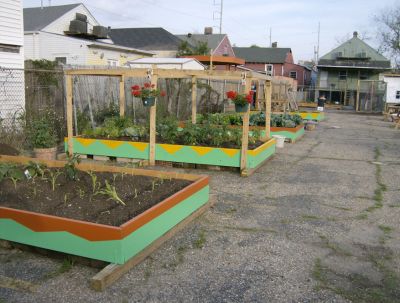
 Mid City Community Garden

Compost from Eco Cafe is used in Mid City Community Garden

Eco Cafe is quite a contrast to Venezia, the owner of which, Anthony, did not once mention a relationship the other restaurants or the neighborhood during our interview, except when talking about the past.  I got the impression that he used to feel more connected with the row and the residents, but that after the storm, many of his regulars moved out of Mid City and now commute to his restaurant.  As far as the Neighborhood Association goes, he told me that if I could tell him what the annual fee for being a member was, he would be able to recall if he was, in fact, a member.  I asked if he was, then, not exactly passionate in participating in the association with the other restaurant owners.  He laughed and said no.

My other establishments to research are Subway, which will not respond to my attempts to contact them (though in their defense, I am having just as much difficulty tracking down Jen and Erich of the Ruby Slipper – if you are reading please call me!) and the Red Door, a formerly rowdy, though reportedly calmed down favorite neighborhood bar.  I have high hopes for these last two establishments to really tie it all together for me.