Pizza Galore

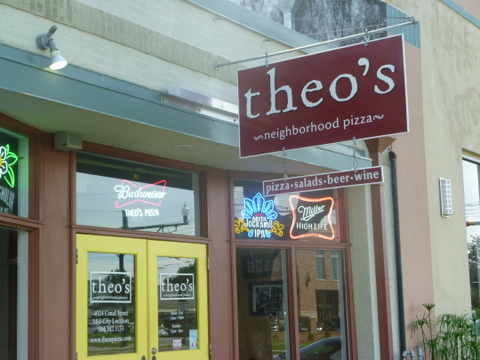
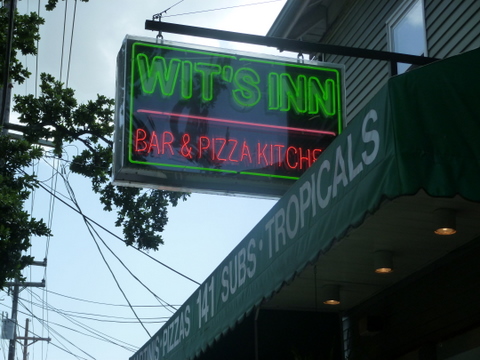
I spoke with two guys about pizza this week.  One was James “Jammer” Orintas, one of the owners of Theo’s Neighborhood Pizza, located on Canal, right near the intersection with Carrollton.  The other was Dennis Scheuermann, the owner of Wit’s Inn, which is on the corner of Carrollton and Iberville.  Both had great insights into the neighborhood and the restaurant business.  Orintas, along with his partners, is from Arkansas.  Scheuermann grew up in the 9th ward and has deep roots in New Orleans.  This contrast alone suggests that they both personify New Orleans at this point.

Both restaurants sell pizza.  I am pretty sure that their pizza pies are made in substantially different styles (I’ve eaten Theo’s pizza many times, but I have not yet tried Wit’s Inn pizza…I’ll try to make up for that soon).  Theo’s is a thin crust pizza that is often referred to as “St. Louis Style.” I have heard that Wit’s Inn pizza has a thicker, chewier kind of crust.  They both seem to have a lot of fans (I am not going to try any restaurant criticism here, so you’ll have to do your own research if you want to decide which one you like better).  Theo’s has only been in the neighborhood since mid-2009 (they have another location on Magazine Street), while Wit’s Inn has been around much longer.

Interestingly, they do not see themselves as really competing with each other.  Theo’s serves beer and wine, but is primarily, as Jammer told me, a destination for families with kids who want an affordable and relaxing night out (indeed, I can verify that the place works for that – I’ve been with my kids, other people’s kids, hordes of kids…).  Wit’s Inn has a full bar and a more diverse menu (they also do brunch on Sundays), pool tables and various electronic games-of-chance that only adults may use.  Indeed, you must be 21 to enter Wit’s Inn.  Wit’s Inn seems to be a mixture of sports bar and neighborhood hangout, with the addition of a full kitchen and professional chef.

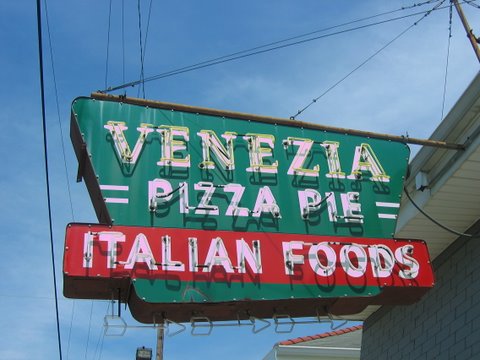
All of which seems like a happy situation, with the potential for both businesses to thrive.  Except that they are not the only pizza purveyors in our restaurant row.  Venezia, just across Carrollton from Wit’s Inn, is famous for its pizza.  Just up the street, across the Great Divide, there are outlets for Papa John’s and Domino’s.  If you are willing to travel slightly out of our research area, down to Banks street, you will find the Crescent City Pie and Sausage Company and Lazaro’s Pizza, which is nearly a secret pizza purveyor as far as I can tell. (Just to confuse matters, the owners of Juan’s Flying Burrito, which is around the corner from Theo’s, also own Slice, another local pizzeria, but they do not have a location in the neighborhood.)  New Orleans is not a town known for pizza.  And yet, you might think we have more pizza places than po’boy shops.

And now, the Italian Pie folks are opening a new store at 125 N. Carrollton, on the same block as Fiesta Latina, Doson Noodle House and Wit’s Inn.  Italian Pie is a local chain with a fairly large number of stores across the metropolitan area.  I have no idea what the new place will look like, but I do know that their pizza is popular with many people in New Orleans.

Which raises a question: is it possible to have too much pizza in a neighborhood?  The immediate issue is one of competition and survival.  Can all of these places thrive with so many different pizza options?  There are subsidiary issues, like parking, that come to mind.  Perhaps the different kinds of pizza make these all substantially different kinds of restaurants.  Jammer pointed out that one of the things that makes the neighborhood attractive is the wide range of affordable dining choices, from various types of pizza, to different kinds of Latin American food, Italian, Chinese, Vietnamese, etc.  Do people see the pizza places as too much of the same thing or do they differentiate between them, so that each draws on their own clientele?  Does the collection of affordable restaurants bring in business for everyone?

What kind of mix of businesses, or just restaurants—succeed in neighborhoods?  How do urban planners and policy makers think about this?  There is some interesting stuff written about this—in urban planning literature, as well as in hotel, restaurant and tourism business literature (and if you have a favorite article or book to recommend, let me know!)—but take a look at this meditation on business diversity in Washington DC (part 2 is here).  It raises an interesting set of issues about restaurant and business clusters that are worth thinking about.  What has your experience been, in our restaurant row or somewhere else where restaurants congregate? Is there a pizza tipping point? Or even a point at which a neighborhood has too many restaurants?  Or maybe not enough?  And would that point be different in New Orleans, where people love eating in restaurants, than in a different city, where food is less central to the way of life?

Doson Delivers

On Thursday of last week, our RRR group met for lunch at Doson Noodle House. While enjoying our meal, I noticed Mr. Ha sneak in with his briefcase. Luckily, this gave me the opportunity to catch him and arrange an interview. When I asked, he said he was free right then and there (which would have been perfect had I not forgotten my notes!) so I decided that I would wing it. Even though I was improvising, I was still able to find out a lot about the history and inner-workings of Doson Noodle House.

Mr. Ha got his first taste of the restaurant business while he was working as a busboy in San Francisco. While there, he met a chef from Shang-Hai who taught him the Chinese style of cooking. In 1978, Mr. Ha moved to New Orleans, and he has been there ever since. In 1997, he opened Chinese’s Chinese on Oak Street. The name eventually changed to Doson Noodle House before the restaurant made its move. One week before Hurricane Katrina, Doson Noodle House’s new location (135 N. Carrollton Ave.) was set to open. After Katrina struck, the restaurant had to be completely redone, yet Mr. Ha says that Doson was the first restaurant to open on N. Carrollton after the storm. He said that there were days when he would open to a line that was at least three blocks long.

When things settled down, Mr. Ha says that he noticed many of his customers from Oak Street had migrated to the new address. I asked him if he knew many of his customers by name, and he said absolutely. He then pointed to several tables in the restaurant explaining who people were, whereabouts they worked, and that many of them frequented Doson’s several times a week for lunch. He also said that I would be surprised by the amount of deliveries the restaurant makes during the week.

While talking with Mr. Ha, I also had to opportunity to take a tour of the kitchen. Everything was spotless and several cooks had their own personal stations. One lady was hand-rolling the spring rolls (which are amazing by the way!) until they looked just right. Another lady was making Pho with fresh ingredients. The walk-in freezer was humongous, and I saw the biggest wok I had ever seen. While touring, Mr. Ha informed me that most of his vegetables come from local farmers and that if he, himself, would not eat something, then he most definitely would not serve it to someone else.

Not wanting to overstay my visit, I thanked Mr. Ha for his hospitality and gave him my business card. I’ve been invited back whenever I wish, and he said next time I’m welcome to talk with some of his regulars if they’re willing. So if you’re a regular to Doson Noodle House, beware! Other photographs and more to come next week.

The Great Divide

N. Carrollton and Bienville

Every restaurant in New Orleans closed during Katrina and the subsequent floods.  As the flood waters receded, restaurants cleaned up and re-opened, each one a sign that life was returning to the city.  In fact, the return of food-related businesses (including grocery and convenience stores, gas stations, drug stores, as well as restaurants) became a kind of index that could be used to measure the city’s progress toward recovery.

But what exactly did that measure?  The question of what constituted a sign of recovery became the object of a brief, but telling controversy.  In August 2006, a year after the floods, the Louisiana Restaurant Association published a survey indicating that only 46% of the businesses in the area had been certified for reopening by state health officials.  Only 34% of food businesses in New Orleans proper were certified at that point.  This suggested that progress toward recovery was very slow.

One of the more prominent local restaurant critics, radio personality Tom Fitzmorris, wrote an open letter disputing the LRA’s numbers.  Fitzmorris argued that a meaningful measure of recovery would focus only on the restaurants that “mattered,” in determining the health of the local economy and culinary culture.  High-end restaurants in the French Quarter, he asserted, were “real” because they shaped the image of the city for both locals and tourists, while the neighborhood Chevron, selling doughnuts and hot dogs, or even Starbuck’s, did not.  The core criterion, he wrote, is that a restaurant be of “real interest to people who like to eat.”  Fitzmorris had been tracking the re-opening of the restaurants he thought mattered and, at that point in late 2006, by his measure, over 80% of the city’s restaurants had reopened.  That suggested a more vigorous recovery was underway.

It seems that Fitzmorris won that argument.  At least in New Orleans, it is unlikely that anyone would dispute that the restaurant scene is quite lively.  He continues to measure the number of restaurants open and, interestingly, he claims as of July 23, 2010 that there are 1,106 restaurants (that matter) open in the area, which is a few hundred more than were open before the 2005 disaster.  This is quite remarkable, given that a recent study, published in Nation’s Restaurant News, points out that there are actually fewer restaurants nationally now than a year ago.  We can probably assume that the NRN counts restaurants that Fitzmorris would not include, so the divide between New Orleans, with its interestingly vigorous dining scene, and the rest of the country, is probably even greater than the mere numbers show.

In fact, the national numbers suggest that independent restaurants are declining the most, while chains are doing somewhat better.  In New Orleans, it would seem—and I do not have numbers to back this up, just a sense from reading local critics and wandering around town—that the opposite is true.  We seem to have fewer chains and more local independents.  This leads me to the Great Divide in our Mid-City research area that inspired this set of observations.  There are a few dozen restaurants in the vicinity.  Most of them are independently owned and local establishments, although a couple (Juan’s, Theo’s, Fiesta Latina) are the second or third restaurant in a locally-owned group.  However, there are also a few representatives of national chains in the area, mostly at the northern edge of our study area.  These include a Subway, a Papa John’s, a Wow Café, a Domino’s Pizza and a Quiznos.  (Just for the record, Fitzmorris includes the locals with multiple shops, including those I note in this paragraph, but he does not count any of the national fast food chains mentioned here.)

On N. Carrollton

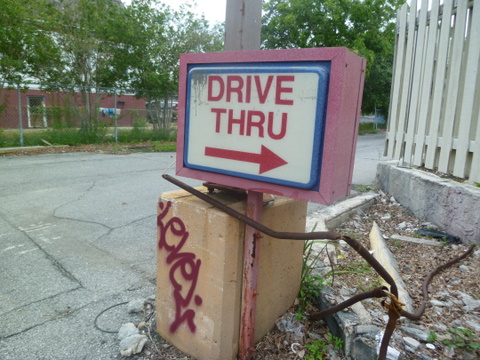
We are trying to include them in our research.  After all, they do serve food and they are quite visible.  It is unclear at this point how much we can learn.  The restaurant owners of the local establishments have been almost universally eager to join in the project.  Of course, they want to be in our planned museum exhibit and they no doubt want the publicity, but I think that they are also clearly engaged as members of the neighborhood and of the city.  This is where they live, after all.  We have had a very hard time making contact with the fast food owners and franchisees.  First, we have to track them down.  When we speak to the local shop managers, we are often (quite brusquely) informed that they cannot speak with us and that we will have to contact corporate headquarters.  Following up usually results in a parade of voice-mail menus, emails that never receive replies and, generally speaking…a vast void.  There are, of course, public records and a great deal of data we can incorporate.  We have photographic evidence they exist, as you can clearly see.  We do not know yet whether or not these establishments want to be seen as part of the community.  We have not (yet) included them in the web site list on the right of this page, precisely because they do not have local sites that we can find, only national ones.

The divide between the local and the national chain seems, in this case, to be rather sharp.  Yet these shops clearly employ local residents and serve local customers.  They are right there, in the community.  We are not ready to count them out.  In fact, we are still determined to include them in our research.  Any advice on how to do that would be welcome!

I Did Not Miss My Calling as an Archivist

I went to the District Civil Court to trace the chain of property owners for several of the restaurants in our project.   Seth Gray had told me about his trip to the Conveyance District (the branch of the DCC that houses the property archives of a certain time period) – his account of his research not only sounded wildly successful, but like something that I could do too.   He had sold me on the romance of digging through title archives in a stuffy silent room of the Court House so, armed with a pen and no real idea what I was doing, I set off.

After greeting me, the office receptionist plugged the addresses of my restaurants into the archive computer and rattled off instructions for what I needed to do next, utilizing a vocabulary and acronyms mostly unknown to me.  She must have sensed I had not followed her completely (possibly the vacant expression on my face – a result of my confusion and increasing light-headedness from not eating that morning) so she took a moment to write down all of the stats she had just looked up on my properties and told me to head to the fifth floor. On the fifth floor, an archivist was called over to assist me.  He, like the woman downstairs, began talking to me in archive speak.  My first reaction was to nod knowingly at what he was telling me about districts and notaries, etc., so as not to give myself away as an absolute research novice, but I reconsidered, realizing that would not be effective if I actually wanted to learn something.

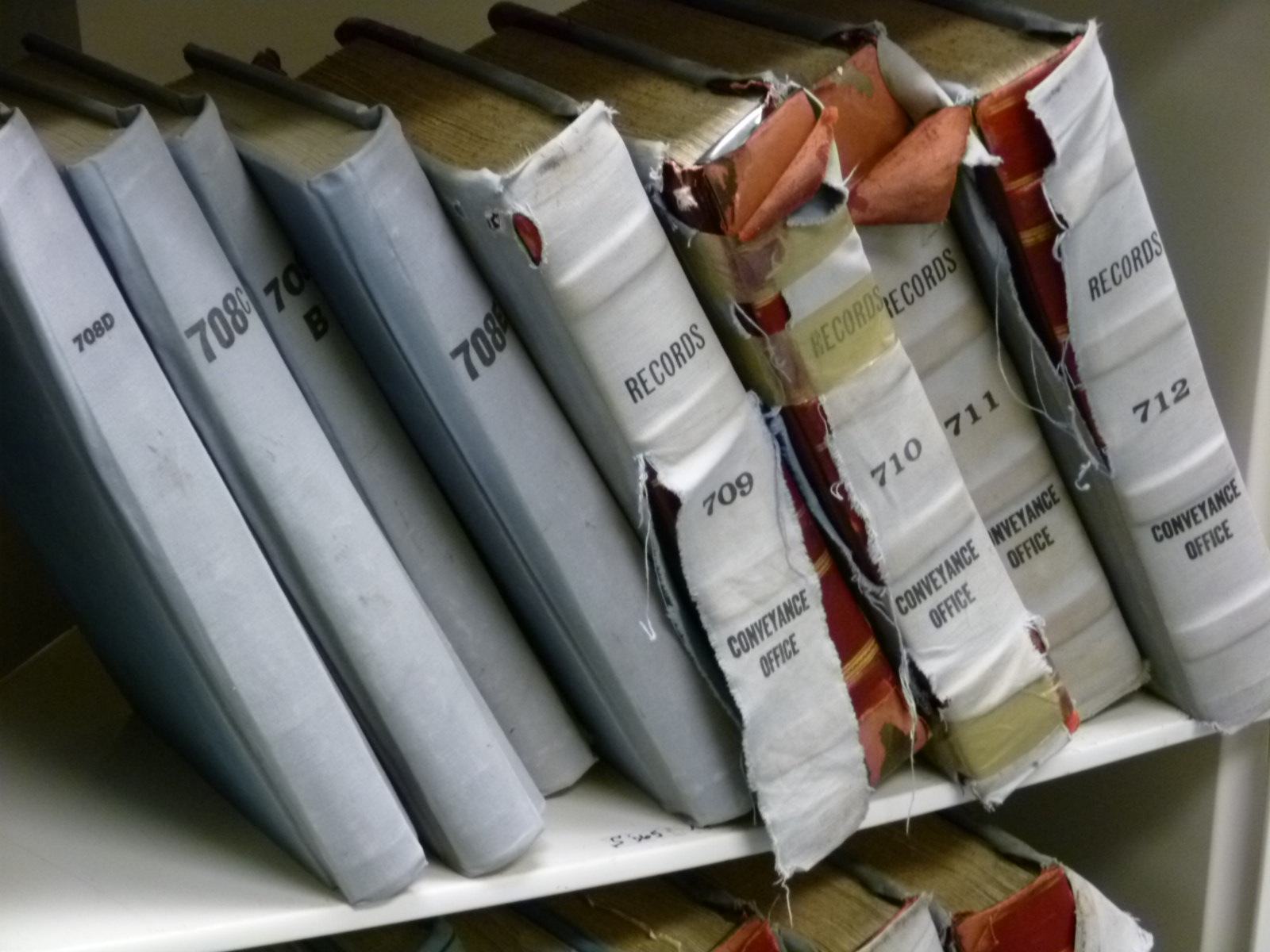
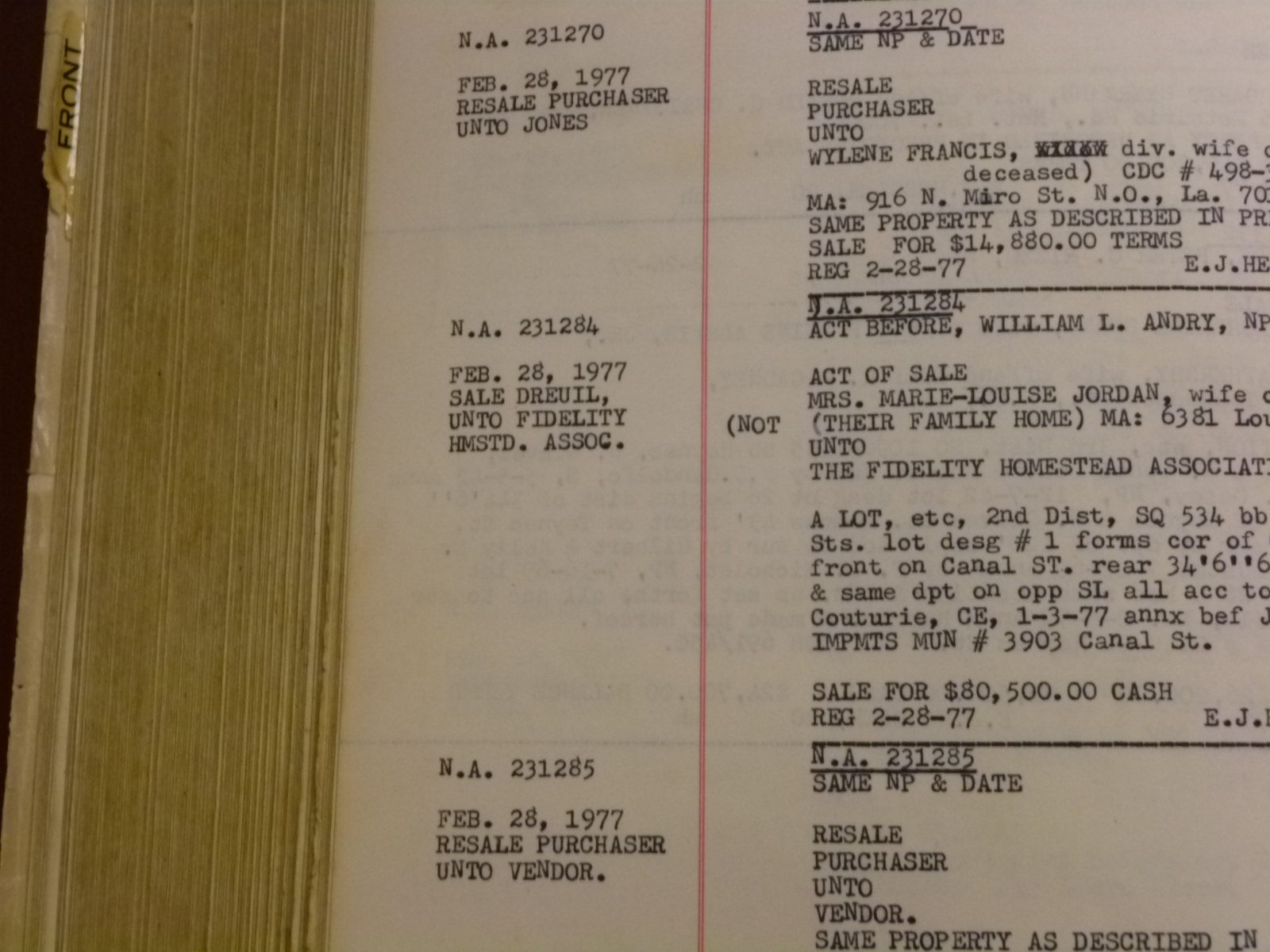
The archivist set me up with five or so gigantic metal bound books of property title changes.  By set up, I mean I had these books in front of me on a long table where I could bend over awkwardly to read them .  For whatever reason, chairs were not made available for this type of research, but Seth was right about how excellent these documents are – they list births, deaths, divorces, and aliases of all parties involved.  They even list the previous spouses of all title vendors and vendees.  The information seemed too personal to be public domain.  I wanted to photograph some pages and handwritten property notes, but wasn’t sure if photography was permitted.  Rather than asking a researcher, like a normal person, I tried to capture the footage sneakily. Not so sneakily as it turned out, when I was unable to turn my camera to silent so that my every button push was accompanied by a chime .  I was like a really bad, boring spy.  Needless to say, my photographs from that day are not top-notch.  I am currently in the process of compiling title tracks for each of the restaurants I will be researching and have vowed to be more collected and adult-like the next time I return to the Civil District Court to complete these traces.

Shadows

All that is left of Popeyes at Canal and Carrollton.

Our restaurant row is haunted by the shadows of restaurants that no longer exist.  Of course, there are businesses that have failed, just as businesses do anywhere. There are retirements, sales and other transformations.  But here there is also before and after the floods, pre and post K.  After hurricane Katrina, when the federal levees failed, the neighborhood stewed in the flood waters for weeks.  There were heroic efforts by restaurateurs to save their businesses, but not everyone succeeded.  Lack of housing, employees, money or even willing family led some to choose not to rebuild.

One part of our project is focused on finding out what happened. Some restaurants have been replaced — El Renconcito in the place of Pho Tau Bay, or Cafe Minh where Michael’s Mid-City Grill once stood, Little Tokyo in the space occupied by the ill-fated but delicious Chateaubriand.

Others have left empty spaces in the neighborhood.  On one corner of Canal and Carrollton there now stands an overgrown lot where a Popeye’s once stood.   The building next door used to be a sushi restaurant with an affordable lunchtime buffet.  It now houses a furniture store.

The church that was Christian's.

The church that was Christian's.

One of the most lamented losses is Christian’s, a gourmet Creole bistro housed in a church, on the corner of  Iberville and North Scott streets.  One of the founders of Christian’s was Christian Ansel, a member of the same family that has run Galatoire’s in the French Quarter for a century.   Chef Roland Huet made the kitchen famous.  The restaurant was known for the unusual setting and for wonderful food, including sublime cold smoked soft shell crabs.  Rumors abound concerning the possible return of the restaurant; but nothing seems to be happening on the site…except that it was restored and used as a church (of all things) for a while since Katrina.  I would like to know the fate of Chef Michel Foucqueteau, a creative French cook who showed me a delicious way to make shrimp (not personally – I just watched him at a cooking demonstration at the Crescent City Farmer’s Market until I learned the recipe).  If you know where he is, let us know.  We’d love any artifacts from Christian’s as well.

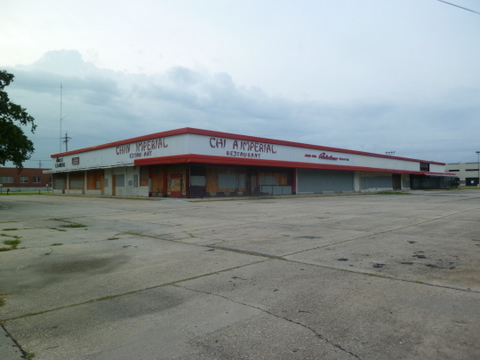
Empty strip mall, 5 years after the floods.

And then there is this.  An entire strip mall sitting empty.  There used to be a Chinese restaurant here, as well as a daiquiri shop (like ’em or not, these places are popular hang outs for New Orleanians) and a smoothie stand.  Now, just an entire city block of decay.  A large pool of darkness in an area that otherwise sparkles with light and life.  Know anything about this place?

In fact, we would welcome any comments, insights, memories or artifacts you have about any of the missing restaurants in the area.  Leave a comment here or contact us through the contact tab above.

Eating Your Feelings

When I told a friend about the restaurants that would be the focus of our project, she lit up at the mention of Mandina’s.  This is where her family has always gone immediately following the funeral of a relative.  In fact, she told me, members of her family have become so accustomed to the ritual of post-funeral dining, that many of them now make a point to eat at Mandina’s after any funeral – family or otherwise.  Eating one’s way through a difficult time seems to be characteristic of many New Orleanians – evidenced in the aftermath of the 2005 storms, when local papers and the Mid-City Neighborhood Organization posted almost daily updates on the projected reopening dates of the beloved Restaurant Row ; as if residents couldn’t wait to eat away troubled thoughts at Brocato’s or Venezia and be assured that all would be well  because the restaurants were back.

Now, most of them are back and we are trying to establish what it is about them specifically that has so endeared them to the community.  Why are these businesses flourishing and in such concentration?  “Zoning,” was the response  David Beriss got from a restaurant affiliate to this question – an answer a bit deflating for a few moments for us, who are hoping for something more curious and charming than zoning to explain the vibrant area.  I gave this some thought, deciding that location in the row alone was not a guarantee of success for a food establishment.  Our research team is now collecting stories of the early years of business for the restaurants as told by owners, employees, and customers.  So far I am most impressed by the adaptivity of the establishments.  One restaurateur told me she had to change her menu completely three times within the first months of opening earlier this year.  She and her patrons are still trying to agree on what her restaurant should serve.  Anthony of Venezia said that his restaurant used to be open till all hours for pitchers of beer and pizza.  At that time they were drawing in a student crowd.  Now he said they mostly do large parties and family gatherings.  Maybe I should recommend my friend check out Venezia as another great after-death meal spot.

Welcome to the Restaurant Row Recovery Project

New Orleans is a restaurant town.  Tourists who come here know that, of course.  In fact, restaurant owners say that people often come for the music and leave talking about dinner.  Yet one of the things that makes the city’s restaurant obsession distinctive is that it exists at least as much for locals as it does for visitors.  There are bistros and neighborhood joints everywhere, it seems, often in places where tourists never tread.  You can get a great po’boy or have a wonderful plate of seafood in nearly any neighborhood in the city.  These are mostly local restaurants, not the casual dining and fast food chains that define eating out in much of the United States.  In an era of increasingly homogenized dining, New Orleans’ restaurant obsession—and the broader culinary culture of which it is a part—seems like an anomaly.

We want to figure out what makes it work.

Based in the Department of Anthropology at the University of New Orleans, we are a team of researchers (1 faculty member and 4 intrepid undergraduates) trying to understand the links between a collection of restaurants, the surrounding neighborhood, and the distinctive culture of New Orleans.

The neighborhood is called Mid-City, a mixed-income, ethnically diverse part of New Orleans full of interesting people and an amazing array of architecture.  We are specifically focused on the restaurant row that runs roughly from the Little Tokyo at the corner of Bienville and N. Carrollton down to Juan’s Flying Burrito near the corner of Carrollton and Canal, while taking a little detour down Canal toward Mandina‘s and The Ruby Slipper, in one direction, and toward Café Minh in the other.  This takes in nearly two dozen eating establishments…a fascinating collection of dining opportunities and small businesses (if we pushed the geographical limits a bit more, we could bring in several other restaurants, but we only have so much time).

The area has long been characterized by a significant cluster of restaurants and bars.  Some have been there for a long time (Mandina’s has been a restaurant since 1932 and the family has had a business in the spot since 1898), while others are very new (Yummy Yummy Chinese Restaurant opened in 2009).  Even before the 2005 floods devastated the neighborhood, the restaurants were a diverse bunch, including both old-line Creole Italian restaurants, sushi, French haute cuisine, fast food and a famous purveyor of tamales (Manuel’s, now departed).  Many of the old restaurants are still there and they seem to be thriving.  There are also new restaurants that reflect the city’s changing demographics, including three Latino restaurants, a Vietnamese restaurant (with a Chinese history), and others.

When the floods cleared, the recovery began and the restaurant cluster seemed to lead the neighborhood in rebuilding.  Angelo Brocato’s Ice Cream and Confectionary was one of the first to reopen in the area, in September 2006, 13 months after the storm and 101 years since they first opened in the French Quarter.  It seemed like the businesses came back, renovated and reopened even before many of the people in the area came back.  There is still a shuttered strip mall, which once housed a Chinese restaurant, a daiquiri shop and a few other businesses, as evidence of the destruction.  But there is also much that is new.

This is where we are conducting our research.  We are out there interviewing restaurant owners, managers, cooks, waiters and busboys.  We want to know their stories and the stories of their businesses.  We are researching the history of the area, trying to determine when the cluster developed, what facilitated it, and what sustains it.  We are taking pictures, making videos, writing notes and collecting artifacts.   This blog will serve to showcase our intermediate findings, our thoughts, questions and insights.  We’ll put up a picture or two.  Maybe we will make you hungry enough to go out to eat at one of these restaurants (careful, many of them are packed at lunch and dinner already!).

We think that this restaurant cluster is a key part of New Orleans culinary culture.  Our results will show how the restaurants are connected to the neighborhood, the city and to what makes this place distinctive.  We are working with the Southern Food and Beverage Museum to put together two exhibits (one on-line, the other on-site) in the fall that will showcase our findings.  And, of course, we will endeavor to write-up and publish our results.  There will be much to say!

Posted by David Beriss