Strategically Located Hidden Gems

I had never really been to the Restaurant Row Recovery area other than as a quick drive by on my way towards other parts of the city. As it turns out this area houses so many culturally important destinations that at times I felt like I didn’t know the city at all.  So often “we” rarely venture outside of our comfort zones and truly experience what else the city has to offer.  I’d never heard much about many of these staples of New Orleans culture that were hidden gems in a sea of traffic and congestion. Yet, it seems like everyone already knew about these places, already understood their significance as a part of daily life. The almost limitless food options have made for a fun research experience.

So what and why should anthropologists care about food?  I think it tells us about what we think is important, clearly not all of the options are nutritionally significant nor financially attainable for some but here you have all types of restaurants and people coming together in crowds to enjoy what this area has to offer.  For the business owner, does this area attract people that would otherwise go elsewhere? With so many options what type of relationships are present?  What, if any community organizations bind them together?

So why do these certain spaces attract people?  What is it about the growth of this centrally located area that continues to grow and adapt to the major changes throughout the city?  When we consider the disparity on what we spend our money on, we find that food and entertainment has a special place.  Sometimes food as entertainment attracts us in ways we never thought of.

Thus far, some of the research teams have already delved into some of the big questions?  Like why are these restaurants here?  What are the relationships between them?  As anthropologists, I think we want to know the hows and why, the histories and social structures behind what makes these restaurants tick but we rarely get to know their back stories. I’ve particularly enjoyed eating in many of these places in the process of initial “research” as a way to understand the clientele, the menus, the employees and even the environment.

It’s been said that we are what we eat and what we eat reflects who we are.  To some extent understanding food and our relationship with it, gives us a better understanding of our culture and what it means here in New Orleans. To some, New Orleans cuisine is a masterpiece of culinary craftsmanship full of flavors and combinations otherwise unknown to the world at large… while to others, it is largely just a deep fried over gluttonous mountain of sauces masking the purity and natural flavors of whatever the given dish may be.  It seems like our relationship with food is complex and fraught with challenging contradictions, whether you are a local, a tourist or a new transplant to the city. Despite being the wealthiest nation in the world, 45 million Americans will rely on food stamps this month to put food on the table for themselves and their families. Food hardship, or the inability to afford enough food, affects families around the country, particularly those with children and throughout this city.  So how does an area full of choices impact not only the surrounding community but the entire city at large?  This area has a multitude of interesting selections but it is home to many staples of New Orleans culture that somehow potentially touch us all.  Through investigations on the how’s and why’s perhaps we can learn just a little bit more about ourselves and our city in the process.
The Restaurant Row Blog Returns!

Post by David Beriss

The blog is back! In case any of our loyal readers were wondering, work on the Restaurant Row Project was put on hold at the beginning of the 2010-11 academic year, as the valiant team of researchers was swept back into the challenges of daily life in the university. Of the team’s student members, two have subsequently gone on to graduate and pursue other careers, while the other two are nearing graduation and promising futures at this time.

Which leaves me, the professor and organizer. I remain bothered and frustrated by the unfinished nature of our work. What do we really know about this restaurant row? Why is it here? Are there patterns that we can see in the way it has evolved over time? What challenges do restaurateurs face in this neighborhood? I had always hoped to bring the project to some conclusion. I want to be able to show some insights into how our restaurant row is connected to the city itself. I think the way it has evolved can tell us something about where New Orleans has been and where it is headed.

It turns out, even without my initial crack team of eager researchers, I have some very useful resources. I frequently teach classes in applied urban anthropology, full of more sharp-eyed students, ready to ask good questions, observe the details of life, spend hours in musty archives and sift through data. I am teaching one of those classes right now, in fact, and have engaged my students as a new research team. They will build on the excellent work of the original crew over the course of this semester. Divided into pairs, they have already begun to collect data and make observations. They will begin blogging in this space regularly over the next week. Over the course of the semester, they will be delivering their fieldnotes to me regularly. At the end of the term, each team will make a presentation of their findings and deliver a report on their work. Perhaps most significantly, they will each produce a poster, combining texts and images that can be used to frame exhibits about the restaurant row.

When we last checked, the restaurants in our neighborhood had largely recovered from the 2005 floods and were beginning to deal with the BP oil spills’ impact on their menus, customers, and future. We will explore the consequences of that ongoing disaster on the restaurants.

Other changes have occurred as well. There are new restaurants in the area—Redemption, the Canal St. Bistro, Katie’s, Blue Dot Donuts, Italian Pie, Rue 127, Juicy Lucy’s—that make the area even more of an eating destination. As alert readers may note, these are not all exactly new. A few are rebirths of pre-2005 restaurants that had not happened yet when we were last in the field. Others are new locations for New Orleans local chains. Each has a story that we hope we will be able to tell.

The neighborhood is also facing a significant new challenge. One of the last parts of the restaurant row that remained undeveloped following the 2005 floods—the area of Carrollton avenue between Bienville and St. Louis—is now slated for redevelopment. A supermarket, a variety of local retail and a few national chain restaurants are expected to move into the space. Work, it seems, will begin shortly. This coincides with the impending development of a greenway that will link the neighborhood with the French Quarter. All of this will make for an interesting future for our restaurant row.

The applied anthropology research team will complete our initial project, helping us understand the social and cultural processes that frame this particular restaurant row. In addition, their work will help us establish a cultural baseline for understanding subsequent changes in the area. There is no doubt that the neighborhood will continue to reflect processes at work in the broader city. I hope that my students are able to shed light on where those processes are taking us.

“This is NOT a Cannoli” (But What Is?)

The very first day I went in to Brocato’s I was overwhelmed by the sheer variety of confectionary delights.  Some things were familiar to me as things that are distinctly Italian even though I myself may not have had them before.  There were jars of candy coated Almonds, a variety of biscotti to choose from, spumoni, and rum cake. Then there were the cannoli.  Or at least I thought they were cannoli.  However, they were listed as cannocini with a small sign below, distinctly stating: “This is NOT a cannoli.”  I was intrigued, because knowing what they were not did not help me in figuring out precisely what they were.  They appeared to be Italian cream filled cylinders, and I was failing to distinguish the difference.

My confusion regarding Brocato’s wares involved their frozen treats as well.  During our interview, Arthur Brocato repeatedly referred to his frozen concoctions as “Italian ice creams”.  I had considered them to be gelatos and ices.  When I looked to their website for clarification, I noticed the following: “For the true connoisseur, Brocato’s offers a complete selection of “gelato” (Italian for ice cream) featuring all natural imported Sicilian flavorings from chestnut to moka to amaretto.”

So, according to Brocato’s, “gelato” is Italian for “ice cream”.  Not being convinced that there wasn’t a bigger difference, I scoured the internet, and after looking through numerous Chowhound posts, Wikipedia postings, About.com answers and endless other streams of running commentary on the subject, I gathered that the general consensus is that gelato actually contains milk and cream as opposed to just cream and that the fact that is seems to be superbly creamy in comparison to its ice cream counterpart has more to do with the fact that it is mixed slowly enough that air doesn’t whip in, allowing for a much denser creamy texture.  As for the cannocini: when I finally gathered the determination to display my ignorance of Italian desserts and ask for the difference, I was told that they are filled with sweetened custard filling rather than sweetened ricotta as the cannoli are.

I bring up the cannoli and gelato examples not because I wish to nitpick Brocato’s selections and word choices but because I think they serve as excellent examples when it comes to the endless debate on authenticity. If Brocato’s chooses not to call its Italian Ice Cream “gelato”, does it make it any less authentic? Furthermore, if one is to consider the new twists to old tradition, such as spumoni cheesecake, then where does authenticity come in to question? Are we to assume that if it isn’t traditional it isn’t authentic?  If that’s the case, then nothing new or innovative would ever fit the definition, we’d be stuck in time forever, slaves to authenticity.

Several people have asked me how I feel about Juan’s Flying Burrito (another of my research subjects on the row) when compared with El Rinconcito or Fiesta Latina.  In other words, is Juan’s “authentic” Mexican food?  I would say that it all depends on the definition of authenticity.  I come from a place where a burrito is food to be held, lunch packed to go.  At Juan’s the burritos barely fit on the plate and they are often drenched in sauces.  Grasping one would be highly inadvisable. Does it make them something other than a burrito? Not if Juan’s says that’s what they are.

Care for a Drink

I was recently discussing the subject of booze with a friend, a topic most people know at least a little about, or at the very least have an opinion on.  He felt many people seem to have a negative view of booze in general.  This friend, as you may have guessed, is not from New Orleans.  I tried explaining to him drinking here is different.  I argued that in a place like New Orleans drinking, like eating, is a special thing and does not carry the same stigma as it may elsewhere.

Needless to say the conversation got me thinking about alcohol and New Orleans foodways.   There is a discernible booze focus in some areas of our fair city– Bourbon Street comes quickly to mind, as does drinking and parading which goes hand-in-hand for many Carnival attendees.  But outside of that where does booze fit into our perceptions of New Orleans foodways?  Does drinking in general have the same assumed negative connotation in New Orleans as it does in other parts of the country?  Is the stigma (if one exists) lessened when alcohol is consumed with a meal?  Does dining at a restaurant provide a positive opportunity to have a cocktail that is absent from home meals?

Many restaurants look to bar sales to improve their profitability.  Some places focus on alcohol sales to the point where food seems like the compliment.  WOW Café and Wingery is one such place where I believe drinking a beer at noon is acceptable because it was paired with a food that, to me, requires a crisp beverage.  Another place I learned a lunchtime draft is acceptable came during our group meeting at Theo’s Pizza, where again I found the food offerings to be complete when paired with a pint.

La Taqueria Geurrero is the only restaurant I am studying that did not have hooch on hand.  They will, however, hop over to The Red Door – a full service bar discussed more by our very own jyocom– to procure anything you may like.  The lack of bar facilities makes them unique amongst the restaurants I am studying.  Rinconcito, Fiesta Latina, Wow Café and Wingery, and The Carrollton all offer (or offered in the case of The Carrollton) full bar service.

Fiesta Latina is laid out in such a way that the bar area is elevated about 3 ½ feet above the dining area.   This provides some semblance of separation between bar and restaurant, but not much.  The separation in WOW Café and Wingery is nonexistent.  The bar is between the dining area and a large pass-through window that exposes several hard working cooks to the awaiting customers.

This is almost the exact opposite of Rinconcito.  Their bar room is large and stretches the entire length of the property front.  The dining area is situated in the rear of the building, and is separated almost completely from the bar by a moderately sized room that houses the pool table.  This layout almost makes it seem as though going from one room to the next is like going to a different place.

Feel free to share your own food, drink, and event pairings.  We would love to know what you are eating and drinking and how they go together with whatever you enjoy doing, especially if it involves the Mid City Restaurant Row!

Reaching Out

Many of the restaurant owners on our “row” do not see themselves in a common light. They are owners from all walks of life. Most do not belong to neighborhood organizations due to cost constraints.  Although they are neighbors, they are different as different can be.  Indeed, it is difficult to even find a consensus as to whether or not they see themselves as a cohesive “community” of restaurants at all or merely a happenstance group brought about by fortuitous zoning.

And yet, whether they realize it or not, they all have something in common.  Each of these establishments are bringing outsiders in.  People from outside of the immediate Mid City area have connections with this row of establishments.

Some ties are obvious. Brocato’s is an institution.  So is Mandina’s. These are the kind of establishments that one brings out-of-towners to for a taste of New Orleans.

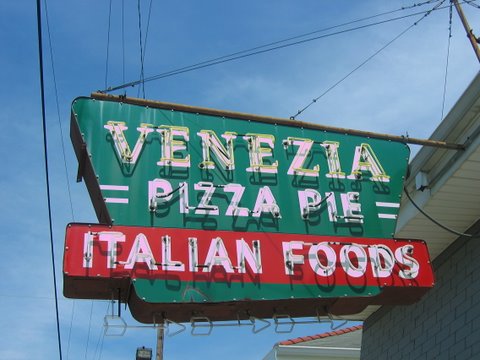
Other connections are more nuanced.  For example, many patrons of Venezia now visit when they make it back to New Orleans, a place they left when Katrina displaced them.  Something about Venezia makes it worth coming back to; perhaps a desire to relive the nostalgia of late night pizza parties with college buddies back in the fifties and sixties.  The owner tells us that these days some people have been known to make the trek across the lake on weekends to stop in for a visit.

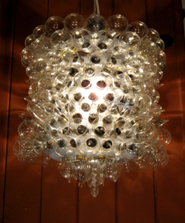
Then there are the ties that few will ever notice.  As it turns out, Juan’s Flying Burrito gets all of its lighting from two local artists, Mark Kirk and Heather Macfarlane.  Furthermore, they provide a link to the artist’s website on their own site to help promote their business.

Light made by Mark Kirk and Heather Macfarlane

The owner of Doson’s Noodle House gets many of his ingredients from the Vietnamese community.  Brocato’s goods can be found at restaurants and grocery stores throughout the city.  In fact, they will even pack their gelato in dry-ice and send to those who yearn for a taste of Italy-or New Orleans. (Check out their site for mail-order Spumoni!)

You don't have to be in New Orleans for a taste of Brocato's!

It would seem that our “restaurant row” is not just a place for Mid City locals, but rather the epicenter of a far reaching web.  If you are one of the many who makes the drive across town (or from out of town!) to frequent a favorite hangout on the “row”, please share your story with us.  We’d like to know what keeps you coming back.

Distinguishing Nationality and Ethnicity: The Food Factor

Where does nationality end and ethnicity begin? On the surface there seems to be an easy answer. Nationality is expressed in the form of governmental controls in which the individual pledges some type allegiance and in turn receives protections and other social services. Ethnicity on the other hand seems to supersede those limitations by including anyone who speaks a particular language, shares in origin beliefs or customs, and/or claims heritage in similar roots. Ethnicity when framed in this way seems much more inclusive.

Foods, and more particularly food ways, seem to challenge the broad sweeping inclusiveness of ethnicity. Nearly all of the restaurateurs gracing our study area seem to strive to stand out as individuals while simultaneously maintaining an adherence to the broader expectations of their potential customers.

Part of the dinning decor at El Rinconsito 216 S. Carrollton Ave.

I began recalling that the meals I have eaten at El Rinconcito – Breakfast, lunch, or dinner – have all been served with soft warmed tortillas. This did not seem out of place prior to my Colombian trip– hence the lack of blog entries – where I feasted on amazing national and regional foods. None of which included even a single tortilla shell. There were close equivalents, of course, known as arepas, but their function seems closer aligned with the pita. Arepas are often stuffed with a meat, cheese, or egg, and either grilled or fried pre or post stuffing. The breakfast ones served on the coastal regions often contained fish or shrimp and were by far my absolute favorite.

Excited to share in this cuisine with my wife I quickly looked over the El Rinconcito menu when I got home and found that despite the obvious Colombian influence, the menu was lacking in the unique food stuffs I found in either urban or rural dinning. Warm tortillas now seem out of place when I go there. Despite their lack of belonging in the South American foodways, however, I do still eat every one.

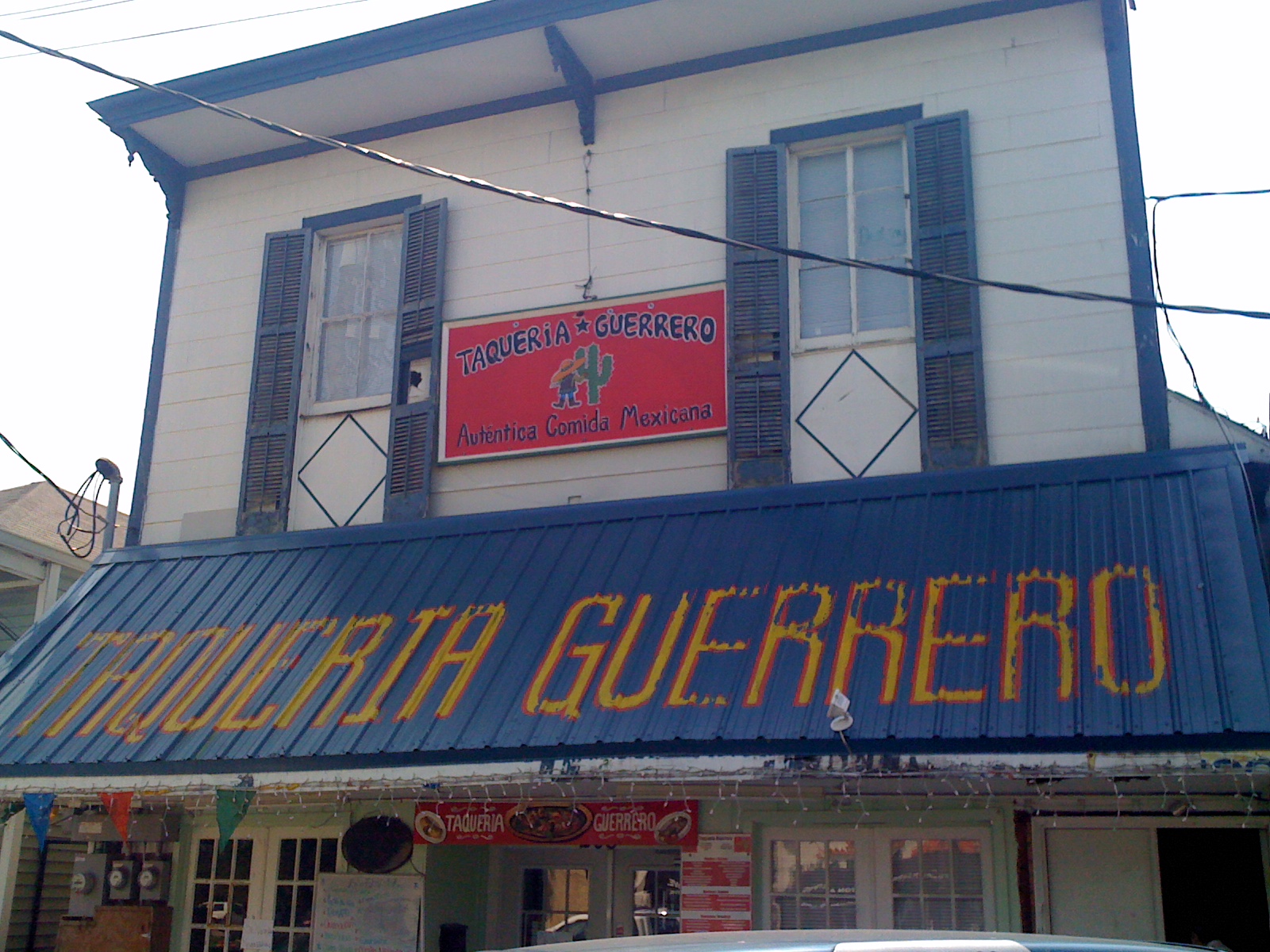
La Taqueria Guerrero at 208 S. Carrollton Ave. New Orleans

Some locations, like Taqueria Guerrero Mexico, Angelo Brocato’s Italian Ice Cream & Pastry, and soon an Italian Pie, are able to easily present national, and even regional, foods because ethnicity and nationality have become synonymous within some categories. Other places, like Theo’s Pizza, Mandina’s, and Juan’s Flying Burrito all claim a type of individuality by expressing a possessiveness over their cuisine variations. Whether the claim is to a particular lineage or place many of the restaurants in our study area claim a similar possessiveness.

Menu for Fiesta Latina of New Orleans

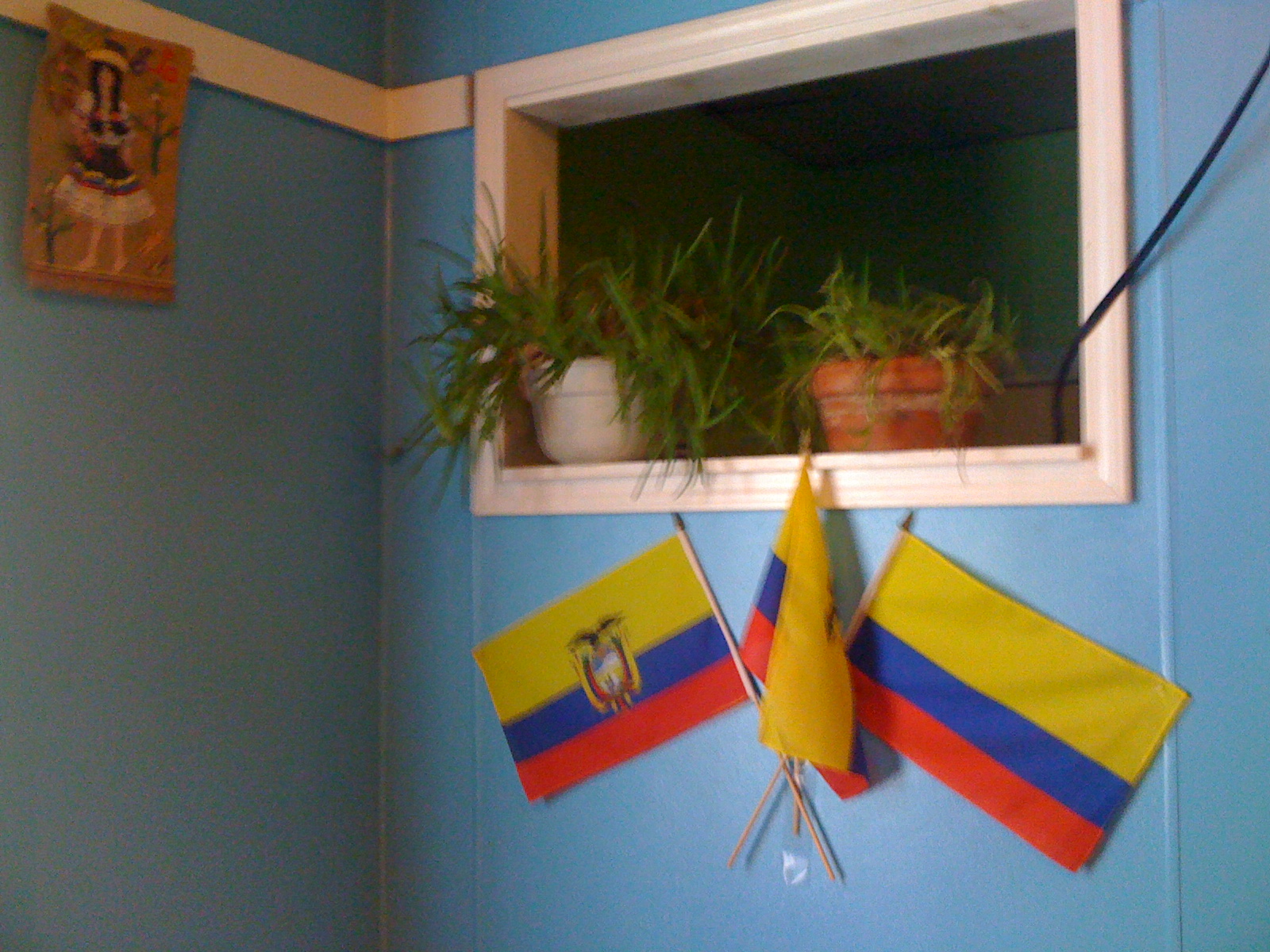
Among the restaurants I am currently studying –Fiesta Latina, El Rinconcito, Taqueria Guerrero, and WOW Café and Wingery – each applies differing regional ties to their menus. Fiesta Latina claims to specialize in Mexican and Central American foods, while Taqueria Guerrero offers more familiar Mexican cuisine. El Rinconcito defines itself as serving Central American and South American dishes. And WOW Café and Wingery – a Louisiana original – has sauce selections named on ethnic expectations – Asian, Bombay, and Polynesian – as well as more regionally specific selections – Texas, Acadian, and Kansas City.

What I want to know is this: what are some national and ethnic foods that you are most fond of? How do the versions of those foods stand up when exported out of their original place of consumption and creation? Do restaurants need to adopt some form of homogenization in order to be successful?

Carrollton Avenue’s Transformation

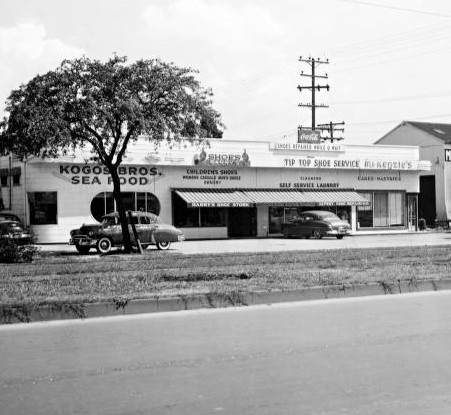
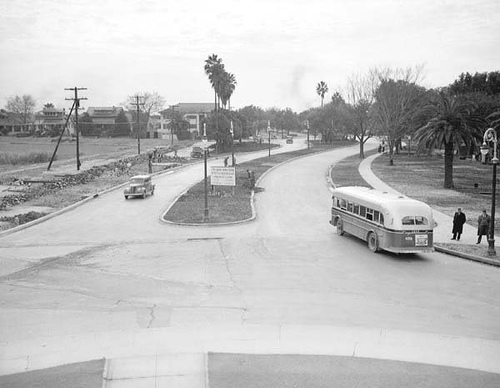
This is a photo of Carrollton's 3600 block circa 1950. Although it was taken several blocks from our research area, it is important to note that the same fate has befallen this strip of businesses as has happened on "the row" - they have since been replaced by 5 Happiness Restaurant.

When I explained to Arthur that part of my project was to map out a history of the neighborhood, he launched into a vividly detailed description of what “the row” looked like when the Brocato family moved there in 1979. The only other food establishments on the street at the time were Venezia (still standing) and Hazel’s Po-Boy’s, an establishment since closed. The Red Door Bar was also around back then, and according to Arthur its clientele isn’t as rough and tumble as it was in the old days. Everything changes with time. The rest of the street was filled with businesses that were functional for the neighborhood. On one side, (Brocato’s side) stood Fashion Forward, David’s Beauty Salon, Johnson’s Hardware, and a used car dealership where Kjean’s now stands. Across the street was Ace’s Pool hall (now Wit’s Inn), a washing machine repair center (now Doson’s), and a sign painting business. A bit further down the road towards City Park was Chaubaud’s Marine, Music City, and a tire repair shop. There was also a small market nearby where neighborhood residents could grocery shop. The building where Brocato’s itself now resides was three different bakeries beginning in the 1920’s.

It seems as though this strip of Carrollton was a sort of one-stop-shop for daily errands. When I asked Arthur what he thought of the neighborhood now in comparison to what it was back then, he told me that things have definitely changed, but he isn’t sure whether or not they’ve changed for the better. He explained that as far as a restaurant boom is concerned, he felt that “the row” had reached it’s peak right before Katrina. Restaurants in general on Carrollton Avenue have come back strong post-K, but Arthur isn’t sure that that’s best for everybody’s business. On one hand, he reasons, variety can bring people to the neighborhood more regularly to eat, but on the other, there might reach a point where there are too many establishments vying for a set group of clientele. Judging by the line out the door on a summer Friday night, I don’t think that Brocato’s has much to worry about. Nevertheless, it is fun to reminisce about spending a productive afternoon in the 70‘s on Carrollton where one could park the car and walk to get one’s hair cut, pick out a new outfit, break for a classic Italian lunch and possibly wind down by playing some pool.

Arthur’s mixed feelings about the numerous food establishments got me wondering what other residents of New Orleans and specifically Mid City think about the changes to the area. If you can recall what Carrollton was like prior to its present incarnation, please feel free to chime in and comment! I’d love to hear what pieces of history our residents have to offer.

This is the intersection of Carrollton and Esplanade circa 1950. Bayou St. John is to the viewer's left and City Park is to the right.

Photos: Upper- courtesy of  www.old-new-orleans.com Lower: courtesy of www.neworleanscitypark.com

Flashback: 1905 “You got what you got”

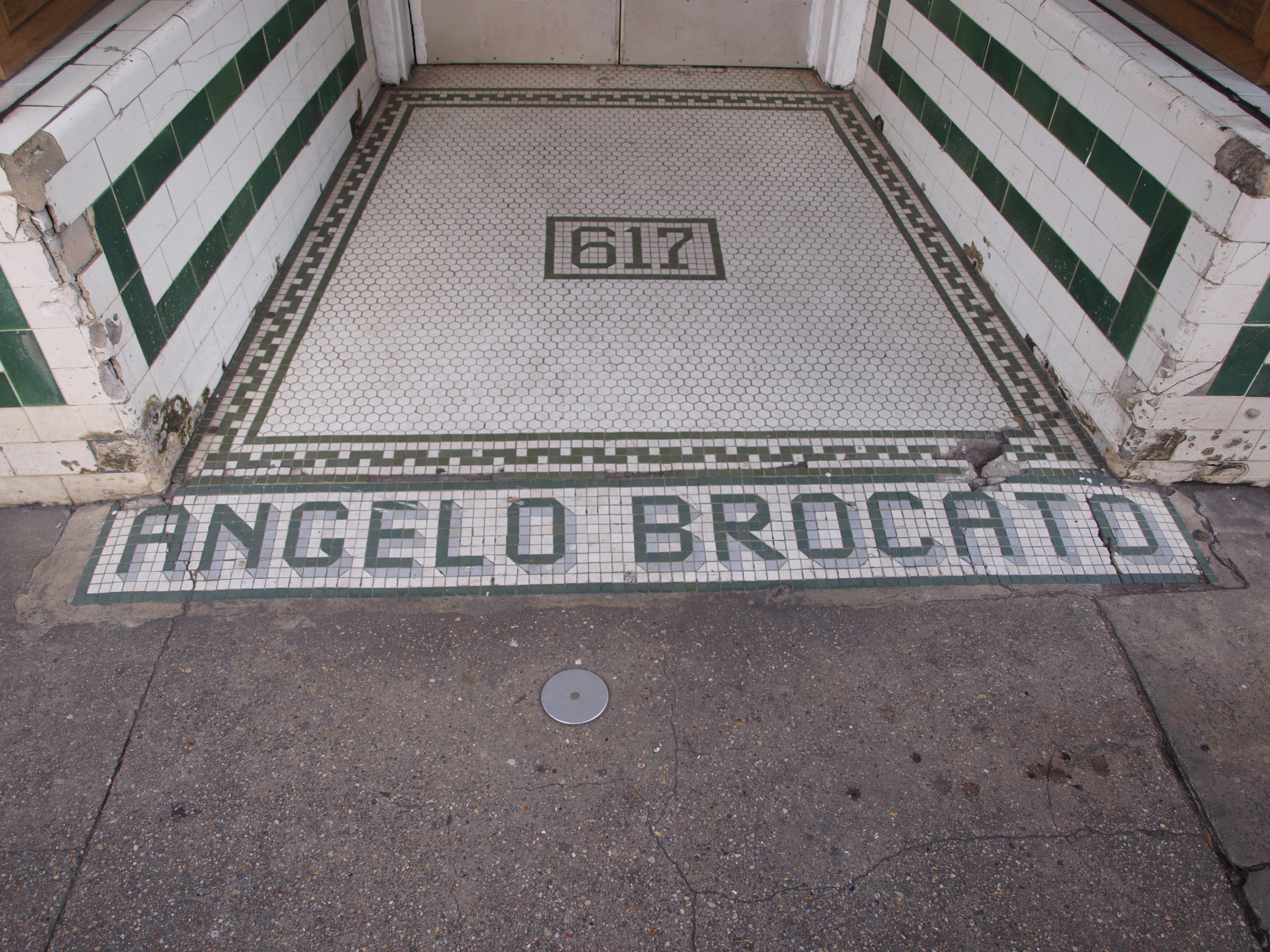
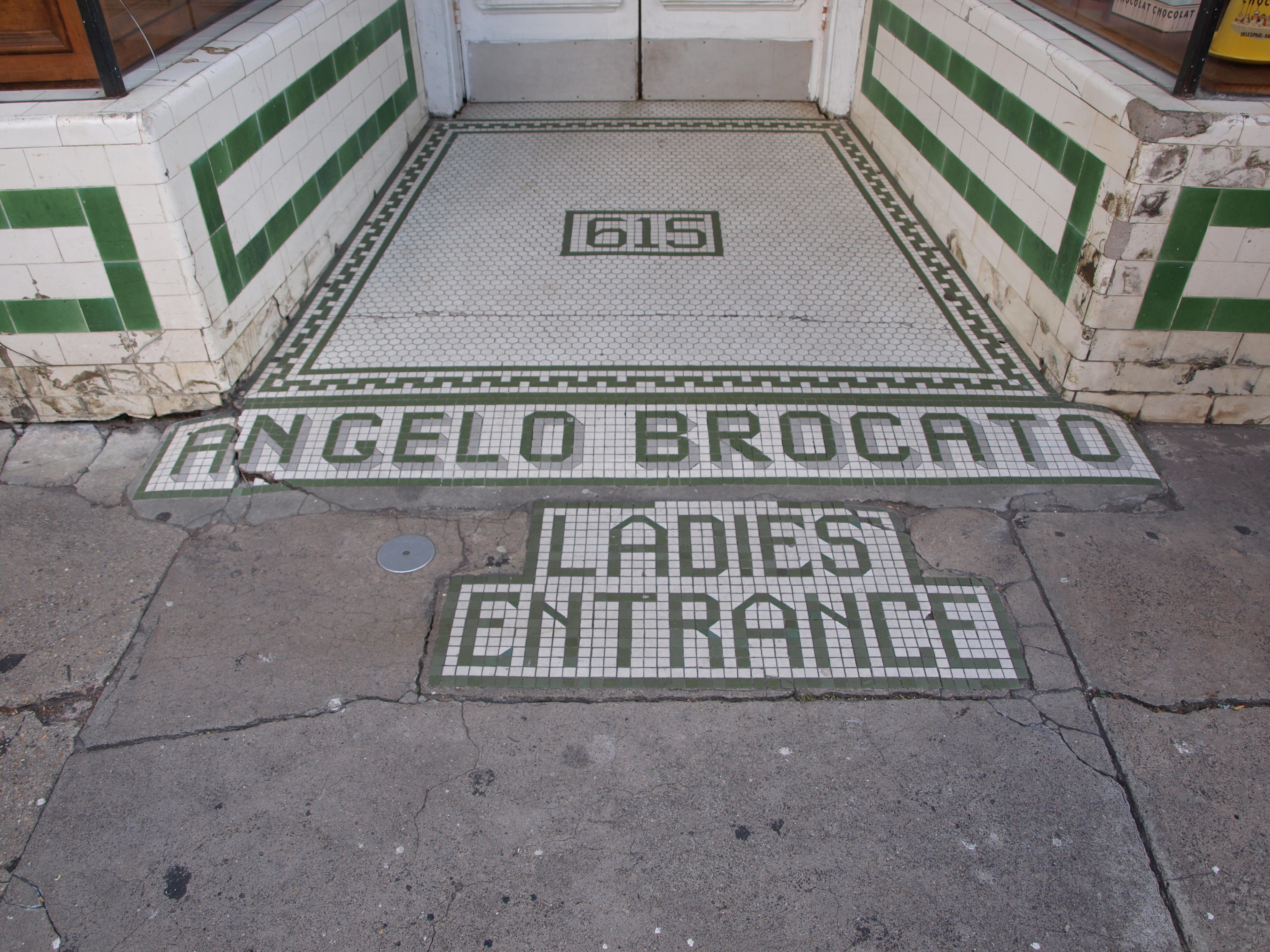
Last week I met with Arthur Brocato, grandson of Angelo Brocato, who was the founder of now famous Brocato’s Italian Ice Cream and Pastry. Because Brocato’s is truly a New Orleans institution, I wanted to make sure that I was well informed on the history of the establishment before I met with Arthur. The Brocato family is aware that a glimpse of their history is sought after by many- over the years the family has been interviewed for food books and magazines, the Gambit, the Times Picayune and even curious college students on reporting assignments. The family has done an excellent job of providing a detailed account on their website complete with photographs to keep those who are curious in the know . When I met with Arthur, I had already done my research and I knew about the establishment’s history so I was looking for something more. Arthur provided me with a very detailed account of what “the row” looked like when they moved there in 1979 from the French Quarter (The account he gave is a story in itself which will have to wait for a another blog entry). Then, as Arthur warmed up to reminiscing, our conversation turned to the way Brocato’s used to be. He told me that when they moved to the Carrollton location his family lived in the back. He pointed out where his kitchen stove once sat before they moved out and expanded retail space. He then moved further back in time to tell me about how things were for his grandfather in 1905 when he opened his business on the 500 block of Ursuline Street ( not to be confused with the location founded in 1921 at 615-617 Ursuline which is now Croissant D’Or).

Sidewalk in front of the 1921 location at 617 Ursuline

And Of Course...The Ladies Entrance at 615 Ursuline

He explained to me that the choice to make both gelato and pastries was one of necessity due to the extreme heat and lack of air conditioning in the French Quarter in 1905. Ices and gelato could be made from roughly Easter to October using copper freezers that were created specifically for the task. The freezer compartments needed to be copper because rock salt used in the ice cream production would react and eat through any other metal. Angelo started making his frozen treats early in the day and made one or two flavors daily. These he sold directly out of the freezers until they were sold out; nothing could be stored. If a customer came in for gelato, they got whatever Angelo had mixed that morning. “You got what you got”, says Arthur. Cannoli, on the other hand, were a wintertime treat. Angelo had no way to refrigerate the creamy cannoli filling which simply could not withstand the heat of a New Orleans summer. Arthur tells me that his grandfather’s first oven was coal burning and had no thermostat. Arthur demonstrates sticking his hand inside the oven and waving it around to test for temperature, a method he tells me he learned early on, working with his grandfather. Listening to the difficulties of running an Italian ice cream parlor in 1905 makes me appreciate the bustling establishment that Brocato’s has turned into. It hardly seems worth it to preserve fruit, cream and ice in extreme heat with no refrigeration, and yet Angelo never gave it up. Today, thanks to the modern wonders of air-conditioning and refrigeration, one can choose from an endless array of gelato and ice flavors, cookies, pastries, and cakes, all thanks to the vision of a Sicilian immigrant who wanted to replicate a little piece of Italy in the new place he called home.

One of five cases filled with treats at today's Carrollton location.

Spumoni Cheesecake! A great reinterpretation of a classic

Here is a short video of Brocato’s selections on July 21, 2010:

Yummy Yummy – A Busy Busy Experience

iPhoneUpload-1.jpg image by GambitWeekly

Recently I went to Yummy Yummy for lunch, as well as an attempt at research. Fortunately, I happened to luck out on both. I arrived right at noon which made meeting with the owners absolutely out of the question. Therefore, I decided that I would make observations instead and scribble them down in my handy little notebook.  First, I must say that everything I witnessed was incredible.

When I walked in, I immediately noticed that there was not an empty table in the whole place. It was swarming with people who were eating, talking, and moving about. People were literally waiting in line to go through the buffet with to-go boxes. The buffet line itself was packed and cooks kept appearing from the rear of the restaurant to replenish empty trays of food. Two pretty girls, my age or younger, were mastering the entire restaurant. They would take turns checking out customers at the register, refilling drinks, supplying napkins, clearing tables, etc. And boy were they fast! These girls flipped tables like I have never before seen.

Though the walls were sparsely decorated, the variety of people within seemed to make up for it. I looked around and saw construction workers, business-folk, young people, families; the list could go on. This made me start thinking: Do these people live here or work here? Or perhaps both? Or the opposite: neither? I mulled these ideas about in my head while I stood in line for my own lunch. At $3.50/lb of Chinese food to go, I knew that Yummy Yummy would soon become a favorite. Hopefully, as I get to know the place better, I might be able to answer my question about the people who choose to eat in Mid-City.

Eating Your Feelings

When I told a friend about the restaurants that would be the focus of our project, she lit up at the mention of Mandina’s.  This is where her family has always gone immediately following the funeral of a relative.  In fact, she told me, members of her family have become so accustomed to the ritual of post-funeral dining, that many of them now make a point to eat at Mandina’s after any funeral – family or otherwise.  Eating one’s way through a difficult time seems to be characteristic of many New Orleanians – evidenced in the aftermath of the 2005 storms, when local papers and the Mid-City Neighborhood Organization posted almost daily updates on the projected reopening dates of the beloved Restaurant Row ; as if residents couldn’t wait to eat away troubled thoughts at Brocato’s or Venezia and be assured that all would be well  because the restaurants were back.

Now, most of them are back and we are trying to establish what it is about them specifically that has so endeared them to the community.  Why are these businesses flourishing and in such concentration?  “Zoning,” was the response  David Beriss got from a restaurant affiliate to this question – an answer a bit deflating for a few moments for us, who are hoping for something more curious and charming than zoning to explain the vibrant area.  I gave this some thought, deciding that location in the row alone was not a guarantee of success for a food establishment.  Our research team is now collecting stories of the early years of business for the restaurants as told by owners, employees, and customers.  So far I am most impressed by the adaptivity of the establishments.  One restaurateur told me she had to change her menu completely three times within the first months of opening earlier this year.  She and her patrons are still trying to agree on what her restaurant should serve.  Anthony of Venezia said that his restaurant used to be open till all hours for pitchers of beer and pizza.  At that time they were drawing in a student crowd.  Now he said they mostly do large parties and family gatherings.  Maybe I should recommend my friend check out Venezia as another great after-death meal spot.