WOW Cafe & Wingery in Mid-City

Today on this beautiful Tuesday afternoon (March 27, 2012) I made my way down Bienville Street, heading to WOW Café & Wingery in Mid-City.  Immediately, I noticed what was happening right across the street from WOW café.  The demolition process had begun for the construction of the Winn-Dixie shopping complex, which will include Office Depot, Neighborhood Pet Market by Jefferson Feed, Felipe’s Taqueria, Five Guys Burgers and Fries, Pei Wei Asian Diner, and Pinkberry Frozen Yogurt.

As I entered WOW Café, I immediately began to take in the sports-themed atmosphere.  Flat screen TVs lined the walls displaying various sports channels.  Also, local high school football helmets are lined throughout the restaurant, along with sports-themed pictures, such as a NASCAR vehicle decorated with the WOW Café & Wingery logo.  It was not very busy at this time, but it did begin to pick up quickly as lunchtime approached.  There was music playing in the background that was mixed with the humming sound of the daiquiri machines that were located behind the bar.  The bar also served many local beers, such as LA 31, Covington Strawberry, Tin Roof Amber Ale, and Tin Roof Blonde Ale.

After I soaked in the atmosphere of WOW, I decided to take a seat at the bar.  The friendly waitresses then greeted me and then took my drink and food order.  I asked them if I could speak with the manager who was working at this time.  The manager working today was Ross McStay.  I introduced myself to Ross and explained to him about our Restaurant Row Recovery project.  He was very nice and said that he would be glad to answer any questions I may have had for him.


After eating my West Coast Veggie sandwich on Texas Toast, I preceded to ask Ross a few questions.  First, I briefly told Ross about the new plans of development in this Mid-City area.  He said that he was aware of the plans, and was quite thankful that something new was finally being built in the area across the street from WOW.  He said that he was tired of having to look at an abandoned building through the windows of WOW every time he was working.  I asked Ross what his opinions were on the construction of the new complex.  Ross replied that he was looking forward to the new complex and that he was happy to have other businesses built because it will bring more people to the area.  He also said that he was not worried about the competition of Five Guys Burgers and Fries, because the majority of WOWs sales come from their wings.

Speaking of wings, as we all know wings are very much associated with football season.  Ross said that he would definitely say that the busiest time of the year for WOW is football season, and not only when the Saints are playing (even though he said that it can get pretty crazy in WOW during a Saints game!).  Any Sunday or Monday night football game always brings in a decent amount of people into WOW Café in Mid-City.  Ross also told me that there is around a one thousand dollar difference in their sales when you compare football season time to other parts of the year.  I also asked Ross if he felt that the majority of their clientele are residents from the surrounding Mid-City neighborhood.  While he might not have known for sure, he felt that, yes, the majority of the clients are from the surrounding area.

I had a very nice and relaxing time speaking with Ross at WOW Café in Mid-City today.  My partner, Mark Paternostro, and I will also be researching El Rinconcito and Kjean’s Seafood.  More to come about our restaurants in the future!  Next time we hope to present some interviews from the owners of our restaurants.  Thanks for following our Restaurant Row Recovery blog and have a wonderful day!

-Rachael Horn

Cafe Minh: one of a kind, a surprising find.

Now let me begin by saying, I am not a food critic. The purpose of my writing this blog is not to analyze the quality of the food or to rate my overall experience by a star system. To each his own, I will make no judgements. My purpose in writing this for all of you is to explain in fine detail the experience I had at Cafe Minh, a hidden gem located at the corner of 4139 Canal and David Street, and to apply that experience to a better understanding of why this restaurant is part of the “restaurant row”. Continue reading

Restaurant Row Recovery — Just the beginning!

Hello! My name is Jennifer Frerichs. Among the many attributes that makes New Orleans one of a kind are its restaurants and I will be exploring some of them. Although I am not a native New Orleanian and it was not the food that drew me here, it should have been. To my luck, I signed up for a class, taught by David Beriss, called “Applied Anthropology”. In this class, my fellow students and I were given an assignment called, “Restaurant Row Recovery.”

 The goal of the “Restaurant Row Recovery” project is to analyze and interpret the transformations of the restaurants within a specific community. This assignment has given me the opportunity to study a small sample of the vast assortment of restaurants within New Orleans. More specifically, this project covers restaurants along the streets of Canal and Carrollton. Together, my partner Deyna Cimino and I have been assigned a quest for understanding of two locations, Venezia (134 N. Carrollton Ave), and Lemonade Parade (4709 S.Carrolton Ave).

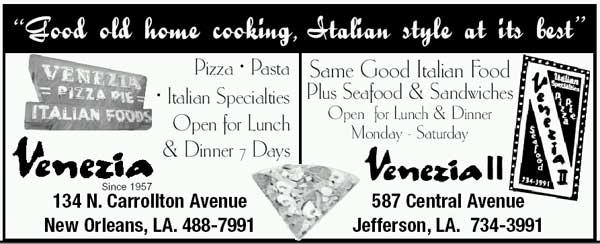
Venezia Restaurant

“Since 1957, Venezia Restaurant has been serving up piping-hot pizza pies and Italian cuisine at its best. Our staff averages 15 years of experience, and they are waiting and willing to offer you a memorial dining experience”


Quote:www.venezianeworleans.com/index.html)

Picture: (by: Jennifer Frerichs) 

Venezia is well known for its family atmosphere and traditional Italian food. My partner and I were fortunate enough to interview the owner and a bartender recently. The enlightening resposes from the owner will be seen on our next blog. Since I arrived early for the interview that our group had established with the owner, I decided to have a seat at the bar and get to know the employees and customers. Starting with the bartender, I asked for the reasons he worked at Venezia. Apparently he has been working at this restaurant for approximately 5 years and he enjoys working with a company that is like a family, rather than working with a commercial chain. He also seemed eager to help me in my research, considering that he too was a UNO student, which I greatly appreciated. He explained that the effects of Katrina caused a lot of damage and resulted in changing some of the interior decoration of the restaurant. Unfortunately, as he began to descripe the history of Venezia in depth, our interview was cut short with the sudden rush of customers. As he walked away, a couple joined me at the bar and after they got their drinks, I decided it might be a good time to spark up a conversation. I started by asking them why they enjoy this particular restaurant. The man stated that he had been coming to Venezias for many years and him and wife always got the same thing and that was the “artichoke dip.”He also went on to say that he has established a relationship with the people working at the restaurant. I refrained asking much more as to not interfere with their experience. For me, the interviews emphasized both the quality of the food and the family atmosphere within the restaurant. It appears the family appeal of this place is what brings the locals back time and time again due to the comfort of the atmosphere. 

Picture: (http://www.nola.com/sites/venezia/)

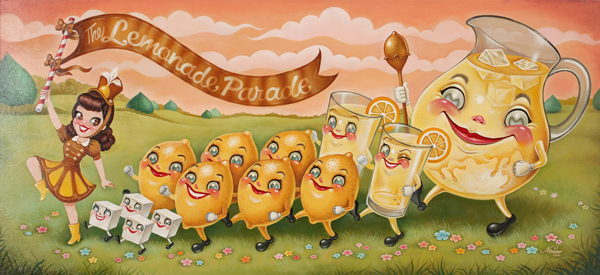
Lemonade Parade

“The bright exterior is a pretty good indication of what is going on in the inside. Like a cheerful clown, Lemonade Parade dispenses happiness to all who stop in.”

Quote:(http://www.gonola.com/2010/10/08/lemonade-parade-a-trip-down-memory-lane.html).

Picture: (http://Jonathanlevinegallery.com)

Lemonade Parade seems to exhibit a similar quality as Venezia, in its aim for “family atmosphere.”  From the outside, their art feels as compelling as an ice-cream truck and they remain very popular to a variety of different age groups. Unfortunately, my partner and I have not been given an opportunity to interview any of the staff, although we have tried to contact them through email and facebook. Due to these circumstances, we will likely have to depend on the history of the business, client opinions, as well as our own observations.

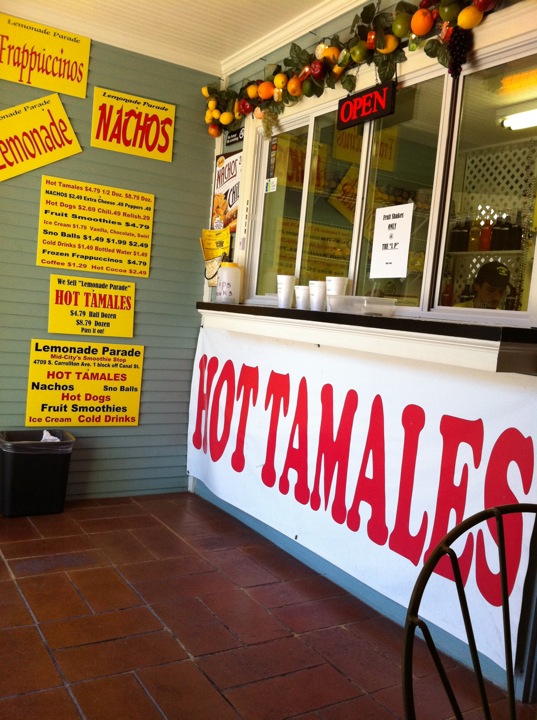
Before Lemonade Parade was in the picture, this location was held by a restaurant named “Manual’s Hot Tamales”. Manuals was founded in 1932 and its name was generated from the well known fact that they were popular for their tasty tamales. “For generations of New Orleans people, the sight of a Manuel’s vending cart at a street corner up ahead, lit by the dim glow of a railroad lantern and emitting aromatic steam on cold nights, was the embodiment of the peculiar regional version of hot tamales. Simmered in an oily slurry of drippings and tomato sauce, they were a far cry from the traditional Mexican tamales steamed in cornhusks” (http://wwno.org/post/tamales-today). Unfortunately, like many other businesses, Katrina inflicted too much damage for the restaurant to reopen. While Lemonade Parade does not serve the same tamales as Manuels, they still please the crowd with their own version of the snack. On review read, “ I love Lemonade Parade! What’s better than a cool, freshly squeezed beverage on a hot day in the neighborhood!? I love the simplicity of their plain iced lemonade, it usually never lasts the 3 blocks back to my house– it’s that good! They also have a wonderful selection of fun coffee drinks and smoothies named after New Orleans songs and events. Let me just say all in all, darn cute and tasty!” (http://www.yelp.com/biz/lemonade-parade-new-orleans-2).

Picture: (https://foursquare.com/v/lemonadeparade/4c44b4202d3ec9b687402fae)

I believe this study should be guided by questions such as:

  • What is the history of this location, more importantly the restaurants within it?
  • Why are these restaurants so successful?
  • Does the introduction of the Laffite Greenway Project pose a threat to the traditional locally owned businesses in this area?
  • In what ways do these restaurants reflect New Orleans traditions?
  • Based on the knowledge we have obtained about these restaurants, what can be said about their future?

Pleasantly Surprised at Wit’s Inn

http://www.witsinn.com/

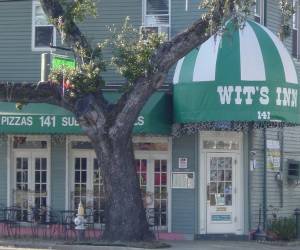
Situated on the corner of Iberville Street and N. Carrollton Avenue, Wit’s Inn is in the perfect location to grab a drink; the food is pretty good as well.  When Haley and I went into Wit’s Inn around 6pm on a Tuesday, we were impressed by all that this neighborhood bar had to offer.  It is a well kept bar and restaurant, arranged with a comfortable amount of open space and appropriately placed bar room games and attractions.  While there are tables placed in the front of the building that seem like they are used more for restaurant purposes, the bar tables that line the right- hand wall continue to the back of the room.  Each table has about four tall chairs and a flat screen TV docked to the wall.  There are two large, flat screen TV’s on either side of the bar that were showing a basketball game and an MMA fight.  Traveling towards the back of the room, a pool table is positioned in the middle of the floor, and a darts board hangs on the back wall.  Wit’s Inn has a pool league; interestingly enough, the building was a pool hall before Wit’s Inn established itself there.  Haley’s and my favorite amenity was the digital jukebox.  The bartender told us that people can choose what songs the jukebox will play by using a phone app, they don’t even need to get up from the bar!

Equipped with a well stocked bar and satisfying menu, the specials that Wit’s Inn offers are worth checking out.  Among them are a free beer with the purchase of a pizza on Monday, and a 3 for 1 drink special on Wednesday.  There are six beers on tap, of which, the most popular seem to be Abita Amber and Blue Moon. The service was excellent; our bartender was attentive and helpful when we asked to talk to him about the establishment.  While Haley and I were there, the crowd seemed to be mostly composed of polished couples who were headed to dinner, small groups out for a drink, and men who looked to be stopping by after work for a drink and some dinner.

Wit’s Inn was in business before Hurricane Katrina, but when it reopened, following the storm, a pizza kitchen was added to the establishment. While the food they offer is surprisingly more restaurant- like than I expected to encounter, it is somewhat over looked.  Alongside the pizza, fries, and sandwiches, you will find salads, appetizers, and seafood entrees. Haley ordered a salad, and I ordered a small pizza.  We would both eat there again.

It would seem that the Lafitte Greenway development has the potential to increase business at Wit’s Inn in proportion to the increase at the surrounding restaurants.  While we heard that they are trying to encourage more people to try their food, business seems to remain predominately around the bar.  In addition, many of the drinkers are stopping by at some point around dinner plans.  Whatever the outcome of the development may be, I will definitely revisit this tucked away bar, and I suggest it to anyone who is looking for a pleasant and entertaining night time outing.

Mid-City Market and Cafe Minh

            New Orleans has well deserved its superlative status in travel guides and top ten lists.  From most romantic destination to best place to party, the city works hard to present itself an interesting and inviting city.  When operating within a tourism economy, the standards regarding entertainment are tremendously high; locally owned restaurants, bars, and music venues have to offer something spectacular in order to remain in business despite increasing competition.  Our specific area of study focuses on 23 restaurants (excluding national chains such as Domino’s and Quizno’s) grouped within an area a little less than one square mile.  For example, there are no less than five restaurants serving pizza within spitting distance of each other.  In theory, such drastically intensified competition would drive potential businesses away, however, the clustered nature seems to have the opposite effect.  New restaurants are continuously opening in and around the area, while many of the restaurants we are studying have been in operation for decades. 

            The primary purpose of this project is to study what makes this particular intersection so desirable to restaurant owners.  Is there a relationship between the restaurants within the area? How do the excluded ‘fast food’ restaurants factor into these queries?  How do the post-Katrina restaurants fare in relation to those with historical ties?  Is there a relationship between ‘the restaurant row’ and the surrounding neighborhood?  Do these restaurants have an influence outside of mid-city?  What, if any, specific audience do these restaurants cater to?  Are they attracting more locals or tourists? 

Image

            With better understanding the connections within the area, we can better speculate how new development will change things.  Construction will soon begin on “the last dead strip” located in the 300 and 400 blocks of North Carrolton Avenue.  The proposed Mid-City Market will incorporate four new restaurants into the area- Pei Wei Asian DinerPinkberry frozen yogurtFelipe’s taqueria, and Five Guys burgers and fries.  Each of these restaurants are national chains and have no direct connection to the city, and many fear that the increasing amount of chain restaurants will cripple the individuality of the existing restaurants.  However, in conjunction with The Lafitte Corridor project, the surge of new development will inevitably attract more visitors and locals alike to the area.  Our project aims to determine how these developments will impact the delicate ecology of the restaurant row.

Image  

         Moving on! For my portion of the project, I will be writing about Cafe Minh and Angelo Brocato’s along with my research partner, Chelsea Hines. Being that this is a revisited project, the history of Cafe Minh has already been covered, and is accessible here.  Cafe Minh is located at the corner of Canal and David, therefore removing it from direct spotlight.  With only a small sign hanging above the door, it can be difficult to differentiate Cafe Minh as a restaurant from the surrounding homes.  With the exception of the large windows, it appears that the exterior of the building was not renovated at all; Porch lights still illuminate the front step.  On the contrary, the interior of the restaurant was very clean and modern. The decorations seemed to be purchased wholesale from an IKEA-type store.  Poster sized prints of flowers and butterflies lined the walls, mixed with hazy black and white scenes of New Orleans more frequently seen in tourist brochures.   In accord with the large, illuminating windows, smooth jazz soundtrack, and freshly cut flowers arrangements the place felt more like an art gallery than an Asian-fusion restaurant.  We arrived late for lunch, and only a few tables were occupied.  The apparent crowd was that of business professionals on a break for lunch.  The staff was exceptionally friendly, and over the course of our lunch three different servers (not including our own) refilled our drinks.  Being a picky eater, I ordered only jasmine rice, while Chelsea got the duck soup.  Chelsea, along with the general population of yelp, said that the food was plentiful, though not fantastic, and therefore not quite worth the price.  Many reviews from locals claim that the quality of the food has decreased over the years, while reviews were more favorable from people who were visiting from out of town. 

            In my opinion, Cafe Minh is one restaurant that could potentially be negatively affected by the Mid-City market development.  For one, neither the décor nor the food itself particularly stood out. The cost of an entrée put Cafe Minh out of the price range to be a neighborhood favorite, while the prints along the walls seemed more relevant to pleasing tourists than drawing in locals. Although, in theory, Cafe Minh has the perfect formula in place for pleasing visitors, its location makes it easy to miss. In its defense, Cafe Minh is one of the few restaurants in our area of study that offer the white linnen experience, and the only of it’s genre do so.  Those who are just looking for a quick meal between office hours, or a cheap bowl of soup might be drawn more towards Pei Wei. Cafe Minh is the perfect venue for a date or a formal meeting, but it isn’t the type of place that you can bike to in the heat of the summer without feeling smelly and out of place.

Discovering food

Hello all, I’m Austen Dooley and this is my first ever blog post so please bear with me. During this semester we have been assigned a research project for Applied Anthropology with Dr. Beriss that deals with the cluster of restaurant in the Canal and Carrollton area of New Orleans. This project is titled the Restaurant Row Recovery Project and our main objective is to discover why this cluster of restaurants exists in this particular neighborhood and why it is so successful. In addition to answering those questions we will also look at the Restaurants progression since Katrina and their feelings towards the Laffite green way project and the new big box retail that is set to break ground as well as the new Mid City Market.  The last question which is more holistically is what the individual restaurants believe the future of this restaurant row will be.  To answer these we have split the class into groups of two and each group was assigned at least two restaurants to research. We will conduct interviews with managers and owner as well as the wait staff, and possibly some regulars if we’re lucky. We will also do some research on the history of the buildings that the present restaurants occupy and in addition do some observations in the restaurants and what I’m most excited about…eating food!

Image

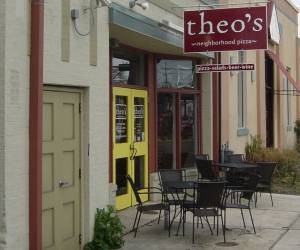
My research partner, Kathleen DeMajo and I were assigned Theo’s Neighborhood Pizza and Canal St. Bistro. I have been a resident of the New Orleans most of my life and to be honest I haven’t been to any of the restaurants in the Canal and Carrollton area with the exception of Juan’s Flying Burrito. Needless to say I was a little nervous and intimidated by the project. However once I started to visit the neighborhood and get acquainted with my assigned restaurants, I began to understand why this particular area is so special, and my fears began to dissipate as we jumped in to our research.  First Kathleen and I visited Theo’s Neighborhood Pizza.  We unintentionally went on a Tuesday afternoon which as it turns out is one of their busiest night due to their 1$ draft beer special. This turned out to be blessing and a curse for us because we able to see a lot of regulars as they came in for their weekly Tuesday visit but the staff in turn were busy and did not have much time to chat with us. We did get to have a quick interview with a server Candice who had been with the restaurant for three years. She explained to us the sincere relationship between the restaurant and the customers which is the foundation of Theo’s Neighborhood Pizza.  While we were doing our initial observation I decided to try Theo’s new Bacon and Blue Cheese Pizza (check out their menu), if you’re a fan of bacon, blue cheese, spinach, tomatoes, and garlic (which are some of my favorites) this pizza is the right one for you, however you might need a breath mint after. I was amazed by how friendly everyone was both the costumers and the staff. Numerous people smiled and nodded as they passed by sometimes an awkward wave or a slight nod. When we first arrived we observed a group of older men setting at the table eating. At first we thought nothing about it just men getting a late lunch or early dinner, however after an hour they were done with their meal and still drinking 1$ draft beer. As the dinner rush came in they greet numerous people coming in and had extended conversations about families and politics. Like I said they did this on numerous occasion, and when we asked Candice about them she told us that they frequented the restaurant many times a week and over the years had established many relationships with Theo’s other customers as well as the staff. This was the first indication to me that this restaurant cluster in the Canal and Carrollton area were more important to the community than just a typical restaurant, this cluster brings people together and that’s something special.

We are still awaiting a response from the owners of Theo’s (which at the moment is not looking promising) to ask them some of the broader questions of our research. But if they do not reply the manager said he would be happy to assist any way he can.  That all for now on the next blog I will comment on my amazing interview with Seth Gray the general manager of Canal St. Bistro and a former researcher of the Restaurant Row Recovery Project.

Establishing Rapport at El Rinconcito

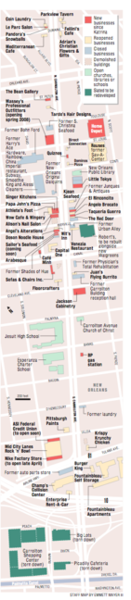
My partner Rachael Horn and I, Mark Paternostro, will be conducting research on three restaurants in the Mid City neighborhood of New Orleans. All three of our restaurants are located on N. Carrollton Ave. between Bienville Ave. and Toulouse St. (refer to the map on the left or here for a larger view).

We chose to carry out research and conduct interviews with three (extra credit, Dr. Beriss?) very different restaurants that happen to be either next to or across the street from one another: a restaurant cluster within a restaurant row, if you will. They are El Rinconcito (218 N. Carrollton), WOW Café and Wingery (231 N. Carrolton #C) and KJeans (236 North Carrollton).

One of the goals of the Restaurant Row Recovery Project (RRRP) is to understand why there are so many restaurants clustered together in this one area. In class, we also noted that, within the Restaurant Row, all of these restaurants collectively seem to be serving a continuum of cuisines that would make the United Nations proud.

On the Row, one can dine at New Orleans’ institutions like Mandina’s, Venezia’s, and Angelo Brocato’s or mix it up at fusion restaurants like Café Minh or Canal St. Bistro or try out some of the newcomers like Yummy Yummy and El Rinconcito (neither of these have websites, sorry bloggers!).

We hope to find through our research if the sheer volume and variety of restaurants on the Row are representative of those who live in the surrounding neighborhood and/or of any demographic changes in the city as a whole.

By researching the history of the area and conducting interviews with the owners of these restaurants, we hope to find out what role they play to the surrounding community and New Orleans as a whole. We also hope to find out in what direction this already dynamic neighborhood is headed with regards to the near-future construction of both the Mid-City Market and the Lafitte Corridor.

February 15, 2012 – Establishing Rapport at El Rinconcito

Rachael and I, Mark, had made plans a couple of days prior to have lunch at El Rinconcito. I arrived first and, in some ways, this was probably for the better because our server, Rosalba, did not speak English and I was able to use my intermediate Spanish to order my food and later ask a few questions.

At first, I just took in the atmosphere of the place itself. There is a sign that lets customers know that to get into the restaurant area it is easier for one to enter in on the side of the building and that’s just what I did. When I entered, a group of Latino men were playing pool to the right of me and there was a very large dining area that was on the left. One of the men that was sitting down handed me a menu and I decided to seat myself.

A few moments later, Rosalba came to ask me what I would like to drink. I asked for horchata but it was not ready so I took a Coke instead. She gave me time to look over the menu and it was during that time I took in some of the material culture found around the restaurant. There were sombreros hanging from a large pillar in the dining area, an outstretched flag that said “Colombia” above the bathrooms, and a few Mardi Gras decorations to be found hanging from the walls and fans. The menu was also a mixture of different types of Latin American foods. The whole menu was in Spanish and I saw everything from huevos rancheros to enchiladas to quesadillas to carne asada and then some.

I decided to go with the Carne Asada (literally translated as “grilled steak”) which also included corn tortillas, lettuce, tomato, queso blanco (I don’t want to call it cheese because that word conjures up a particular image to most Americans. It is literally translated as “white cheese” but its texture and taste are much different than say Cheddar or American. I think it is made from goat milk.), beans, and rice (I list them separately because they were separate from one another unlike the local variety of “red beans and rice”. They also had a much different texture and taste than that New Orleans’ favorite.)

Throughout the meal I had asked a couple of questions of Rosalba. I mentioned to her that I’m a student who is interested in El Rinconcito and the surrounding restaurants and neighborhood. She told me she was new to the restaurant and was from Honduras. She also told me that many of the clients were from many different Latin American countries. I wanted to know if there was someone I could talk to about the history of El Rinconcito in English. She said yes and, later, this became helpful.

As I was thoroughly enjoying a meal that was larger than I had imagined, Rachael and her boyfriend came in to join me on the dining experience. One of the men opened the door for them and they came and sat down next to me. I had told Rosalba that I had two friends on their way earlier and soon enough she came by to get their orders.

Rachael mentioned to me that she liked the relaxed almost homely atmosphere of the place. I wholeheartedly agreed with her. There is something about the light pastel colored walls in each of the dining rooms, our friendly server, the Spanish music coming from the bar, and the group of Latino men playing pool and drinking that seemed to separate us from the busy traffic found right outside the front of the building. After Rachael’s observation, I began to appreciate the fact that the dining area was located in the back and lent itself to this homely environment.

While Rachael and Mac were working on their meals, another lady approached us. She began to ask us in English if we had any questions about the meal or service. I told her that we were students who were researching the restaurants in this area including El Rinconcito. She was very kind and helpful. She told us she would give us the boss’s number and that he would most likely be happy to give us an interview.

After we had finished our meals, Rosalba came back and handed us an El Rinconcito keychain. The keychain has two numbers: one to reach the owner and another for the restaurant. It also says this about El Rinconcito: “No somos los mejores del mundo pero si los mejores del rumbo”.

Before we paid, I had to ask Rosalba one more question. I had no idea what the word “rumbo” meant so I asked Rosalba. She mentioned it’s a Latin American word that is hard to translate to English. I asked her if it meant like the aesthetics of the place or a certain feeling of a place and she said she yes.

Later, we decided to look up the word for ourselves. “Rumbo” actually has many different meanings, but I think the best loose translation would be this: “We’re not the best in the world, but we are the life of the party.”

More to come on WOW Cafe and Wingery and Kjeans… until next time!

the row of restaurants

B. Creppel

There are a couple of things I would like to say before I really start this post. First, I have never blogged before and feel strange even typing the words “post” and “blogged” so I beg of you to be patient with me.  Second, this might sound crazy but I don’t like restaurants. Ok, now release the bewildered look from your face and let me explain. While many people have at one time in their life or another worked in the service industry I am lucky enough (insert sarcasm) to be in the service industry at a whole other level.  I am pretty sure I’m going to regret saying this since I know Beriss is going to bombard me with questions, but my mom (who is chained to her business) owns a restaurant. While my Mom gets the brunt of the work I have the joys of managing, waitressing, bartending, cooking, hiring, making deposits, dealing with paperwork, dealing with employees, and dealing with customers more often then I like to admit. Therefore, hanging out at restaurants in my spare time looking at how and why they work is not exactly ideal in my eyes. Yet, I do feel as if I have the ability to look at the restaurants from a different perspective than most due to my family’s restaurant. Now if your eyes are the eyes of a restaurant owner, then here is a virtual hug and my empathy for you and I am not a hugger.


Now, the goal of this project is to continue the work a previous class began looking at why the restaurants on Restaurant Row in Mid City are successful and how new developments may affect these businesses. I find the first part of this question difficult since there are so many factors that contribute to the success of any business. Location! Location! Location is believed by many people to be of the utmost importance. While I agree that location is a factor of a restaurant, I do not feel that it alone is the “making” or “breaking” factor. When thinking about the project I have asked myself many questions on why a restaurant might succeed or fail, but one has stuck out, “What makes a restaurant on one side of a street a success and a restaurant directly across from it a failure?” If location is of such great importance could a single lane street really have that much affect? Yet, I have seen it happen in different areas throughout the city and it goes to show that the single factor of location is not the only contribution, but many factors are involved and many times are much more complex than we would imagine. We must look at all of the factors affecting the success of the restaurants in the study such as: atmosphere, cleanliness, service, food, cost, and of course location are a few examples.


With the list of “ideals” for a restaurant we have to remain open to other factors affecting the results. Could a restaurant be successful because it is the only one of its kind in the city, or because it has been and will continue to be the neighborhood restaurant where everyone actually knows your name? Sorry that there are actually more questions in here than answers, but I feel there is not necessarily a concrete answer or an answer at all. Sure, I can speculate, but the reality of it is the only concrete answer I can give in regards to my own family’s restaurant is that it succeeds because that’s what the P&L reports say.


This is the part where I realize that I said nothing about the restaurants I was assigned! The two restaurants my partner Emily and I were assigned are Katie’s and The Ruby Slipper and I will be writing much more about them in my second ever blog.

Mid-City Restaurant Row Examined

When Professor Beriss first proposed this project, I was not surprised in the least that it involved food. Having taken one class with him before, I was already very aware of his love of all this fried and sautéed. I was, however, unsure of how we could apply anthropology to uncover how the new construction in the mid-city neighborhood would affect the currently open restaurants. Is that even the role of Anthropology? Are we even allowed to ask those questions? What can I even bring to this project? The answers to all knotty questions have been slowly detangling in my mind for the past few weeks.  

Over the course of this semester, the Applied Anthropology class at UNO will be looking at how the so-called Restaurant Row is going to be affected by the new construction of the Laffitte Greenway Project and the Mid-City Market. Both are scheduled to be completed by 2014, and will include the opening of some chain stores and restaurants as well as a grocery store and an Office Depot.

The row of restaurants we are going to be looking at stretches through the heart of Mid-City. I, Emily Bruner, have been paired up with my friend and classmate, Brooke Crepelle, to look at the Ruby Slipper Café  and Katie’s. Having never been to either of these restaurants before starting this project, I was a little worried about how they would fit in with the more popular ones on Restaurant Row (i.e. Brocato’s, Venizia, Wit’s Inn, etc.). I started to ask around to see if anyone had eaten at either of these places. None of my friend’s (even those who live in Mid-City) had heard of either of them. I will admit, the fact that none of my friends has heard of this place did scare me a little. Usually, if a place is really good, people know about it. Right? Turns out, that is not always the case. But more on that to come….

I personally did not discover the Restaurant Row until the beginning of my sophomore year at UNO. And having grown up in the New Orleans area, that is a pretty pathetic fact. But once I did find it, I began to spend most of my time there. I believe that since Katrina, this part of the city has been growing and becoming a very popular spot for people to go to eat, drink coffee, and hang out. It is interesting that so many diverse restaurants would be packed into the same general area. One point raised in class was that the diversity of the neighborhood was reflected in the diversity of the types of restaurants present. They have everything from Italian Creole to Chinese to Pizza joints to breakfast food to smoothies! There really is something there for everyone. That could be what draws so many people to this area in the first place—no matter what you are in the mood to eat, you can probably find it on Restaurant Row.

 Image                                                                    Image

Continuing The Restaurant Row Recovery Project

Contributed by: Deyna Cimino

In 2010 David Beriss began the Restaurant Row Recovery Project with a small group of grad students in the Department of Anthropology at the University of New Orleans. Two years later Beriss is continuing the research on just what the cluster of restaurants means to Mid City, New Orleans. Our Applied Anthropology class, consisting of mostly undergraduates and a few zealous grads, are once again tackling the question: “What makes it work?”  Our class has been paired into groups of two. Each team responsible for two-three restaurants from Little Tokyo to Juan’s Flying Burrito and from Mandina‘s to Café Minh successfully covering the Canal/Carrollton dining possibilities (in case you’re like me and need a visual here’s a map-courtesy The Times-Picayune and Erin Kinchen).

It is our aim to use whatever weapons necessary, whether they are guidebooks, written archives, or our fellow 2010 researchers to do our best in finding out why the restaurant row exists and what keeps it ticking. I, Deyna Cimino, have been paired with Jenny Frerirchs. Our assignment is to research Venezia’s (located at 134 N. Carrollton Avenue) and Lemonade Parade (4709 S.Carrollton Avenue).

Photo borrowed from InthekNOwla.com

Lemonade Parade is a brightly colored shack-styled one-stop-shop for drinks and desserts. Their menu has a bunch of refreshing items to offer so check them out. Venezia’s is an authentic red gravy savory Italian adventure. Looking forward our fieldwork so that I can try their Eggplant Vatican.

Photo borrowed from: hickswrites.blogspot.com

While researching the area for our initial post, I’ve enjoyed the pictures and history that we’re unearthing. My parents have deep connections with the area—as children, young adults, and also during their professional careers. Talking with them about their take on the block, what it used to be and what it is now, has definitely reinforced that New Orleans’ food culture is ever-changing yet manages to take its own comforting shape in past, present, and hopefully future generations. Lemonade Parade used to be Manuel’s Hot Tamales (est. 1933). It was a small roll-down stand where both my parents remember anticipating a hot batch of Manuel’s finest.

So far in our research, we’ve looked at reviews from the Virtual Tourist where user Virtous_Tourist describes Venezia’s as “softly lit and not terribly fancy […]white table cloths share space with plain vinyl chairs, [where] decades old wall hangings set the stage.” Looking at articles about Manuel’s, the restaurant is almost always described as nostalgic, a legend, or as definitively New Orleans. Lemonade Parade feels like their famous “Rising Sun” (a tangerine, orange, banana smoothie) tastes. Their building is bright and screams summertime and sprinkler fun—even in the winter. So far, it looks like they’re living up Manuel’s reputation. GoNola describes them as “nostalgia for all ages.”  In a Restaurant Spotlight by InthekNOla.com, Mike and Lori Bettencourtt, owners, explain that they originally intended to make the shop a po-boy shack called The Porch. With smoothies this good, I feel like they made the right choice going with Lemonade Parade.

Jenny and I will work with the rest of our classmates to see how this Restaurant Row fits with the current plans with the Laffite Greenway Project and the Mid-City Market scheduled to break ground as soon as this month and reach completion in 2014. We plan to ask the following questions:

1.    What neighborhoods contribute/are affected by the Restaurant Row?

2.    How does the Laffite Greenway Project and Mid-City Market compete/assist the established area?

3.    Why is this a Restaurant Row?

4.    How did it get to be a Restaurant Row?

5.   What is the future for the area?

6.   How are the restaurants related with the community/ with activists inside the community?

Jenny and I are working up interview questions and are planning to visit both places this week. Hopefully we’ll have interview results for the next blog post (depending on owners schedules). That’s all for now. Handing the torch to Troung. Good luck you guys.